
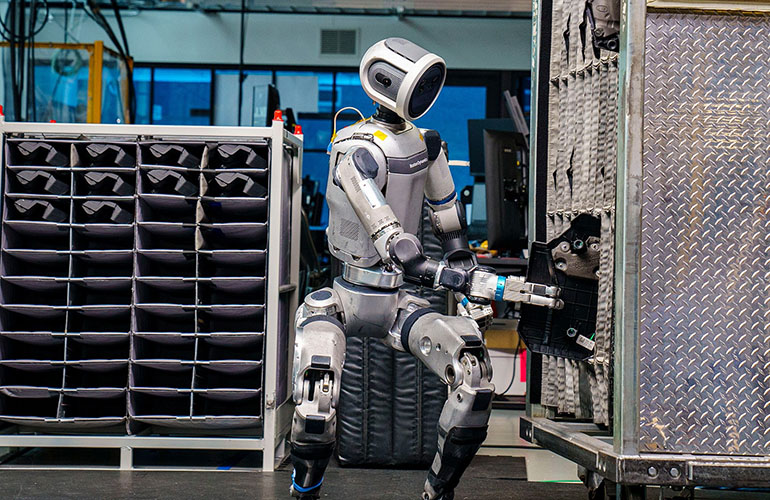
Press / product photography of Atlas humanoid
Image credit: Boston Dynamics (https://www.bostondynamics.com/atlas)
What people are noticing now
The AI boom is no longer confined to software updates or abstract promises. It is increasingly taking physical form — as machines that move, lift, balance, and work alongside humans.
That shift became more concrete when Hyundai Motor Group announced plans to deploy human-like robots in its factories from 2028. The company said the robots would help reduce physical strain on workers, take on potentially dangerous tasks, and prepare its manufacturing system for wider automation over time.
The announcement stands out because it is not a laboratory experiment or a staged technology demo. Hyundai is tying humanoid robots directly to live production lines, beginning with parts-handling and sequencing work in its US factories. That places humanoids inside the real constraints of industrial economics, safety certification, and workforce integration — areas where many earlier robot visions struggled to progress.
What a humanoid robot actually is — and why AI matters
A humanoid robot is defined less by science-fiction imagery than by its shape and purpose. It has a torso, arms, and legs because it is designed to operate in spaces built for people — factory floors, corridors, shelves, and workstations arranged around human reach and movement.
Traditional industrial robots excel at repetition: welding the same seam, lifting the same object, or following fixed paths. Humanoids are intended for a different category of work. They are designed to handle variation — changing layouts, mixed objects, and tasks that do not justify rebuilding an entire facility around a machine.
That flexibility only becomes viable with advanced AI. Modern humanoids rely on machine-learning systems for perception, balance, motion planning, and task selection — an approach increasingly described as physical AI, where intelligence is expressed through interaction with the physical world rather than abstract computation alone. Without AI, a humanoid would be an expensive, rigid puppet. With AI, it can recognise parts, adapt movements, recover from disturbances, and work safely near humans.
From research labs to factory floors
Humanoid robots have been researched for decades. Early systems such as Honda’s ASIMO demonstrated bipedal walking and basic interaction, but they were fragile, costly, and unsuitable for continuous work. They proved what was possible, not what was practical.
Even more capable platforms, such as Boston Dynamics’ Atlas, spent years as research and demonstration machines — impressive in controlled settings, but not economically deployable at scale. The missing elements were reliability, learning capability, and a clear industrial role that could justify long-term investment.
Those constraints began to ease in the 2020s. Advances in AI training, simulation, sensors, and electric actuators made it possible to build robots that could operate for longer periods, adapt to real environments, and improve through feedback. At the same time, labour shortages, safety concerns, and rising automation costs made companies more willing to test new forms of automation.
Hyundai’s decision reflects this transition. The company is no longer asking whether humanoids can move. It is asking whether they can work.
The money and the momentum behind humanoids
Humanoid robots remain a small segment of the robotics market, but the trend is clear. Investment has accelerated, unit costs are falling, and deployments are moving beyond pilots into early production use.
Selected trend indicators
| Indicator | Mid-2020s | Late-2020s direction |
|---|---|---|
| Estimated global humanoid market | Under ~$3bn | ~$15bn by 2030 |
| Typical unit cost per humanoid | ~$200k (2024) | ~$150k by ~2028 |
| Industrial robots installed worldwide (all types) | ~4.28 million | Growing ~10% annually |
| Estimated humanoid shipments | Pilot scale | >10,000 units/year by ~2027 |
| Robotics startup funding | ~$7.2bn in 2024 | Concentrating into fewer, larger players |
These figures do not suggest an abrupt transformation. They point to steady, capital-intensive growth consistent with industrial equipment rather than consumer electronics.
Why factories come first — and why Hyundai’s use-case matters
Factories are the most realistic starting point for humanoids because they are semi-structured environments. Tasks repeat, safety can be controlled, and productivity gains can be measured.
Hyundai plans to begin with parts sequencing: retrieving and delivering the correct components to the right place at the right time. This type of work is physically demanding, often ergonomically harmful for humans, yet still too variable for fixed automation to handle cheaply.
Humanoids can step into these workflows without forcing companies to redesign entire plants. That is their economic advantage. They do not replace existing automation systems; they complement them where flexibility matters more than speed.
Why Hyundai’s humanoid strategy stands out
Hyundai’s approach differs from many humanoid projects in one important way: integration.
The company owns Boston Dynamics, giving it direct control over hardware development rather than relying on an external supplier. It also has guaranteed internal deployment sites — its own factories — where robots can be tested, refined, and scaled under real operating conditions.
Many startups must sell unproven machines to external customers before they have demonstrated long-term reliability. Hyundai can absorb early costs internally as part of a broader manufacturing strategy. In that sense, its humanoids are considered “better” not because they are more ambitious, but because they are more likely to be used.
Why deployment context still matters
Large-scale humanoid deployment does not happen in a vacuum. It unfolds inside real industrial, legal, and labour systems, where unexpected events can quickly affect production plans.
Hyundai’s US operations provide a concrete example. In September 2025, US Immigration and Customs Enforcement (ICE) conducted a large-scale raid at Hyundai’s manufacturing facility in Georgia, detaining around 500 workers. The incident disrupted operations and drew international attention to how labour enforcement, workforce composition, and industrial strategy intersect.
While the raid took place in the United States, the underlying lesson is not country-specific. Any jurisdiction with complex labour laws, immigration rules, or regulatory enforcement can introduce sudden constraints on manufacturing activity. As companies move toward humanoid automation, these contextual risks do not disappear. They become part of the deployment equation alongside technical reliability, safety certification, and economic return.
What this signals next
Humanoid robots are unlikely to flood workplaces overnight. What is more plausible is gradual expansion: first in factories, then in warehouses, hospitals, and other large facilities where human-designed spaces make fixed automation inefficient.
If that path holds, humanoids will become part of the background infrastructure of advanced economies — not as general intelligence, but as specialised physical workers powered by AI. The open question is not whether they will exist, but where they will make economic sense.
My Take
In the history of humanity, humanoids have largely existed as a dream — images we encountered through science-fiction films rather than everyday life. That boundary is now starting to shift. What Hyundai is proposing suggests that humanoids may move from imagination into routine industrial environments.
This is an innovative change. Human-like robots have the potential to reshape factories, oil rigs, and other settings where people face high physical risk. Earlier humanoid efforts focused primarily on mimicking human movement. Hyundai’s approach is different: it targets the replacement of specific workloads, within defined scopes, rather than attempting to replicate humans in full.
I believe this focus signals another industrial transition. As in past eras, humans will need to seek roles driven by judgment, creativity, and responsibility — not simply rely on humanoids or AI systems. At the same time, I am concerned about the degree of dependency that may emerge if these technologies are embedded without sufficient oversight.
To prevent that outcome, we will need to think proactively about how humanoids are used — not only to improve efficiency, but to genuinely enhance human life without diminishing human agency.
Sources
Primary
- BBC News — Car giant Hyundai to use human-like robots in factories
https://www.bbc.com/news/articles/cvgjm5x54ldo
Secondary & context
- Reuters — Hyundai Motor Group plans to deploy humanoid robots at US factory from 2028
https://www.reuters.com/business/autos-transportation/hyundai-motor-group-plans-deploy-humanoid-robots-us-factory-2028-2026-01-05/ - International Federation of Robotics — Record of 4 million robots in factories worldwide
https://ifr.org/ifr-press-releases/news/record-of-4-million-robots-working-in-factories-worldwide - Bain & Company — Humanoid Robots: From Demos to Deployment
https://www.bain.com/insights/humanoid-robots-from-demos-to-deployment-technology-report-2025/ - Crunchbase News — The Year of Humanoid Robots
https://news.crunchbase.com/robotics/ai-humanoid-robots-venture-funding-2024/