
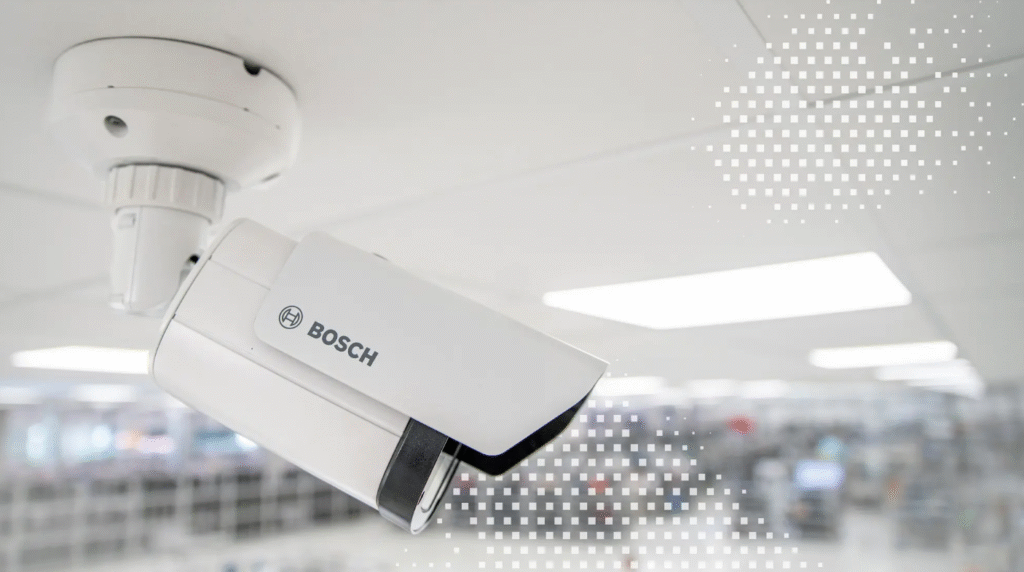
Press / product photography of smart fire-detection system
Image credit: Bosch Security and Safety Systems — https://www.boschsecurity.com/en/products/fire-and-smoke-detection-camera/
What’s changing — and why it matters
Smoke alarms have been among the most reliable life-saving technologies for half a century. Yet modern life is beginning to outpace their limits.
Fires caused by lithium-ion batteries, e-bike chargers, and dense household electronics can ignite almost instantly. In the US, around 16 % of homes still lack a functioning smoke alarm — a striking gap as electrical fires rise again.
The BBC recently asked a simple question: are today’s smoke detectors still enough for modern risks? The answer, increasingly, is no — and the next generation of alarms is being shaped by AI.
From heat triggers to AI eyes — a century of evolution
The first heat detectors appeared in the late 1800s, using metals that melted to close an electrical circuit.
By the 1920s–1950s, physicists Walter Jaeger and Ernst Meili developed ionization-chamber sensors — the principle behind many modern smoke detectors.
The 1960s–1970s saw the arrival of home-use alarms with replaceable batteries, followed by the photoelectric detector patented in 1972.
From the 1990s to 2010s, ten-year lithium batteries and interconnected alarms became standard, while smart devices like Google Nest Protect and Kidde–Ring added app alerts and voice guidance.
In the 2020s, AI-based systems such as Bosch AVIOTEC and NYU Tandon’s CCTV-driven model began analysing video directly, spotting flames and smoke in milliseconds.
Each generation pushed detection earlier and reliability higher — but the leap from reactive sensing to predictive, AI-driven vision marks a genuine transformation.
The global fire picture — fewer incidents, higher losses
Fire frequency has fallen sharply in advanced economies since the 1980s, thanks to stricter codes and widespread alarm use. But the cost of each fire has risen, as modern buildings contain more electronics and valuable assets.
Table 1 — Property damage and loss by region (illustrative global trend)
| Region | 2015 Loss (USD bn) | 2020 Loss (USD bn) | 2024 Loss (USD bn est.) | Trend |
|---|---|---|---|---|
| North America | 19 | 22 | 25 | ↑ steady urban growth |
| Europe | 13 | 15 | 17 | ↑ moderate |
| Asia–Pacific | 9 | 14 | 20 | ↑ strong industrial expansion |
| Middle East | 3 | 5 | 7 | ↑ rapid construction |
| Global total | ≈44 | ≈56 | ≈69 | ↑ persistent increase |
NFPA data show that total US fires fell 54 % since 1980, while deaths dropped 46 % and injuries 50 % — yet property losses (inflation-adjusted) climbed roughly 10 %.
Fewer fires overall, but each one far more costly.
What conventional alarms can and cannot do
Standard smoke alarms trigger only when particles reach the sensor — often too late for today’s fast-burning materials.
Lithium-ion battery runaways can ignite within seconds, producing explosions and toxic smoke long before heat rises to a ceiling detector.
According to NFPA, working alarms halve the risk of death in home fires, yet nearly three out of five fatalities occur where alarms are absent or failed.
Dead batteries and false alarms remain the main causes — gaps that “smart” and AI-enabled systems are now closing.
How AI-powered fire alarms differ
AI detection doesn’t wait for smoke — it sees it. Using deep learning and image analysis, these systems recognise flame and smoke patterns in milliseconds, often from existing CCTV or doorbell cameras.
Table 2 — Detection technology comparison
| Detection Type | Detection Speed | Coverage Area | False-Alarm Rate | Maintenance | Relative Improvement |
|---|---|---|---|---|---|
| Conventional | 20–30 s after smoke contact | Single room | High | Manual battery check | Baseline |
| Smart (non-AI) | 10–20 s | Small–medium | Medium | Self-test via app | +20 % reliability |
| AI-powered | ≤ 5 s (video inference) | Large / multi-zone | Low | Predictive monitoring | + 60–70 % speed & accuracy |
These models fuse vision, heat and gas data to predict hazards and trigger alerts faster than humans can react. For factories, warehouses and large buildings, this difference can prevent total loss.
Global landscape of AI fire detection
AI-based fire safety is spreading across smart-city and industrial projects, led by a few major firms.
Table 3 — Global leaders and strengths
| Company | Region | Core Technology | AI Logic / Functions | Key Strength |
|---|---|---|---|---|
| Bosch (Germany) | Europe | AVIOTEC 8000i IR video fire detection | Deep-learning inference at camera edge | Early source detection; low-light IR capability |
| Honeywell (US) | North America | Multi-sensor AI detection + predictive maintenance | Self-learning thresholds, real-time monitoring | Integration with building automation |
| Hikvision (China) | Asia–Pacific | Thermal + optical AI analytics | Deep networks detect flame & smoke via CCTV | Retrofit potential and smart-city deployment |
Each company applies AI differently, but all move toward multi-sensor fusion + on-device intelligence for faster, more reliable detection.
What this signals next
Fire detection is shifting from reaction to anticipation. Over the next decade, AI alarms will link directly with electrical-fault monitors, emergency dispatch, and building-management systems.
AI doesn’t replace the smoke alarm’s purpose — it extends it, turning a local beep into a coordinated, data-driven safety network.
My Take
People are rarely cautious about fire risks. Many install alarms but never test them, assuming silence means safety.
Yet what truly saves lives is maintenance, accuracy, and speed — not possession.
In an AI-driven world filled with electronics and batteries, early and reliable detection will decide how severe tomorrow’s fires become.
AI can recognise danger faster and from more angles, preventing escalation before firefighters even arrive.
But this cannot remain a private choice. Governments and regulators should treat AI fire detection as essential infrastructure — setting realistic standards, supporting upgrades, and integrating data into public-safety planning.
The more advanced our homes and industries become, the more vigilance we owe to ourselves. AI will not eliminate fire; but it can turn a catastrophe into a contained event.
Sources
BBC News — “They are essential: How smoke detectors are evolving”: https://www.bbc.com/news/articles/cwynxdnj927o
NFPA Fire-Loss Reports & Data (1980–2020 Trends):
- NFPA Fire Loss in the United States
- NFPA 2020 Synopsis
- Florida CFO 2021 Fire Loss Report
- USFA Electrical-Fire Study — https://apps.usfa.fema.gov/downloads/pdf/statistics/v8i2.pdf
- Whisker Labs — https://www.whiskerlabs.com/ting-performance/
- Bosch AVIOTEC — https://www.boschsecurity.com/en/products/fire-and-smoke-detection-camera/
- Honeywell Connected Life Safety Services — https://buildings.honeywell.com/gb/en/news-events/news/2025/05/building-operators-manage-facilities-efficiently
- Hikvision + iThermAI — https://defsec.net.nz/2024/02/03/hikvision-and-ithermai-deliver-ai-based-fire-smoke-detection/
- International Fire & Safety Journal — https://internationalfireandsafetyjournal.com/global-automated-fire-protection-system-market-to-reach-228-5-billion-by-2034/