
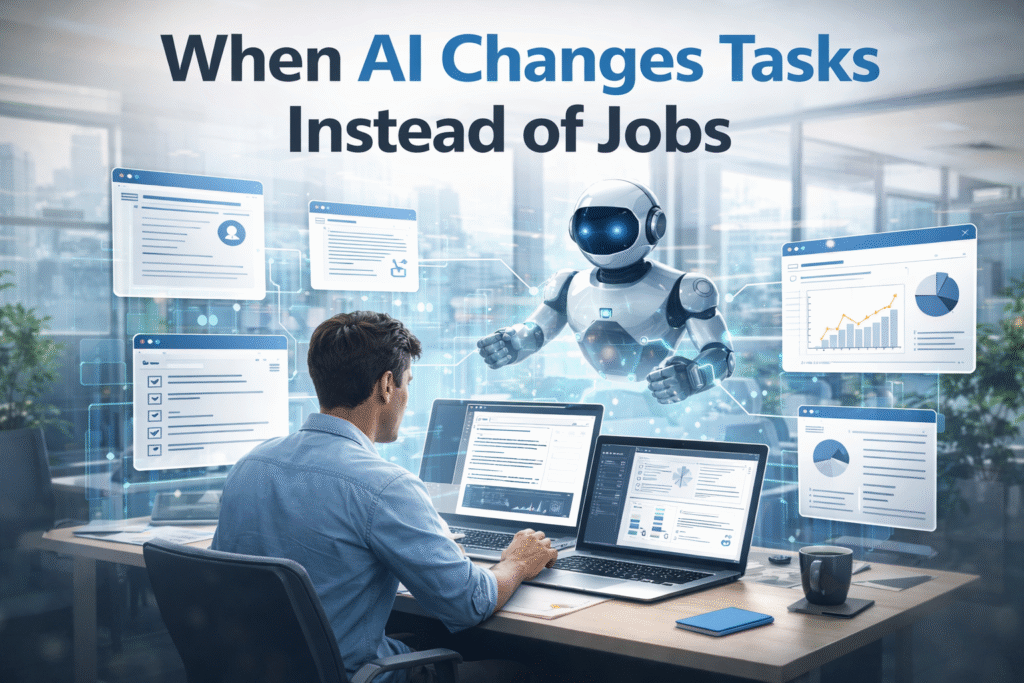
AI is increasingly used within individual tasks, but most workflows have not yet integrated it fully. Image credit: KorishTech (AI-generated).
The Anthropic AI labor report shows that AI is being applied to individual tasks within jobs rather than replacing entire roles. As explored in our previous analysis of the Anthropic AI labor report, this shift reflects a gap between what AI can do and what is actually used in real workflows.
This means the impact of AI appears first inside the structure of work itself. Instead of jobs disappearing, the tasks that make up those jobs begin to shift, with some automated, some augmented, and others unchanged.
Jobs Change Internally Before They Disappear
Most jobs are not single activities. They are collections of tasks—some routine, some complex, some dependent on human judgment.
AI interacts with this structure unevenly. Tasks that are text-based, repeatable, and clearly defined are more likely to be automated or assisted. Tasks that require context, coordination, or real-world interaction remain dependent on humans.
This creates a partial transformation. A role does not disappear, but the balance of its tasks changes.
As shown in the Anthropic AI labor report, even highly exposed occupations still rely on a large share of tasks that are not yet used in AI workflows. This reinforces that change happens inside jobs before it affects job counts.
Work Becomes a Different Mix of Tasks
When some tasks are automated, the remaining work does not stay the same.
Routine components—such as drafting, summarising, or basic analysis—are reduced. What remains is more focused on reviewing outputs, making decisions, coordinating across tasks, and handling exceptions.
For example, a worker who previously spent time writing reports may now spend more time checking AI-generated drafts, refining inputs, and interpreting results. The job title remains the same, but the nature of the work shifts.
This is not a reduction in work. In many cases, it leads to higher output expectations, because automated tasks allow more work to be completed in the same amount of time.
Hiring Adjusts Before Job Loss Appears
Because jobs are not immediately removed, companies do not need to reduce headcount to benefit from AI.
Instead, they adjust at the margin. Fewer new roles are created in areas where tasks are already supported by AI. Existing employees continue in their roles, but the pipeline of new entrants begins to narrow.
This pattern is visible in the Anthropic AI labor report, where hiring into highly exposed roles shows early signs of slowing even without a clear rise in unemployment.
The effect is gradual. Change appears first in hiring decisions, not layoffs.
Workers Experience Change Through Tasks, Not Titles
For individuals, the shift is not defined by losing a job, but by doing different work within the same role.
Some tasks become easier or disappear entirely. Others become more important. New responsibilities emerge around managing AI outputs and integrating them into broader workflows.
This creates a different type of pressure. Workers are expected to produce more, respond faster, and adapt to new tools without a reduction in overall workload.
At the same time, opportunities to learn foundational skills may shrink. Tasks that previously served as entry points—basic coding, drafting, or analysis—are increasingly handled by AI, which can change how new workers gain experience.
Companies Redesign Work Instead of Removing It
From an organisational perspective, task-level AI changes how work is structured.
Instead of eliminating roles, companies adjust how those roles function. Tasks are reorganised, workflows are redesigned, and expectations are recalibrated around what AI can handle.
This allows companies to increase output without immediately reducing staff. Over time, however, it can reduce the need for additional hiring in certain functions, particularly where tasks are highly standardised.
Recent layoffs in parts of the technology sector are often interpreted as evidence of job replacement. However, they may also reflect a shift in how work is structured, particularly in roles like programming where AI can now handle portions of coding, debugging, and documentation. Rather than removing entire jobs immediately, companies may be reducing hiring needs or restructuring teams as fewer people are required to complete the same set of tasks.
The result is not an immediate reduction in jobs, but a slower expansion of roles that are heavily exposed to AI-supported tasks.
Task-Level Change Explains Delayed Job Disruption
The absence of large-scale job loss does not indicate that AI has limited impact. It reflects how that impact is distributed.
When AI changes tasks instead of entire jobs, the effects are absorbed gradually:
- roles evolve rather than disappear
- hiring slows rather than stops
- workflows adapt before headcount changes
This sequence delays visible disruption. Job loss becomes a later-stage outcome, not an immediate one.
What Happens as More Tasks Move Into AI Workflows
If more tasks move from theoretical capability into routine use, the structure of jobs will continue to shift.
At a certain point, the share of automated tasks within a role may become large enough to change how that role is defined. Some roles may be redesigned into smaller teams with higher output per worker. Others may split into specialised functions focused on oversight, coordination, or system management.
However, this depends on how quickly organisations integrate AI into workflows, not just on how capable the technology becomes.
Task-Level vs Job-Level Impact
| Dimension | Task-Level AI (Current) | Job-Level Automation (Hypothetical) |
|---|---|---|
| Scope of change | Selected tasks within roles | Majority of tasks automated |
| Employment impact | Stable employment, slower hiring | Direct job reduction |
| Worker experience | Changing task mix, higher expectations | Role displacement |
| Company response | Workflow redesign, role adjustment | Headcount reduction |
This distinction explains why current labour market signals remain stable even as AI capability advances.
My Take
The shift from job-level to task-level impact changes how AI should be understood.
The question is no longer whether a job can be automated, but how its internal tasks are being reorganised. This reframes AI as a tool that restructures work before it replaces it.
As long as only part of a job is automated, the role persists, but in a different form. Over time, the accumulation of these changes can alter hiring patterns, career paths, and organisational structures without producing immediate job loss.
As more tasks move into AI workflows, the structure of jobs will continue to change even if roles are not immediately replaced. This makes future outcomes difficult to predict in detail, but the direction of change is already visible.
Preparation, therefore, becomes less about predicting specific job outcomes and more about adapting to shifting task requirements. Workers who adjust early to new workflows and expectations are more likely to maintain stability, even as roles evolve or transition over time. The impact may not appear suddenly, but the underlying shift can still affect income stability and long-term career paths if it is not addressed early.
Sources
Anthropic — Labor market impacts of AI: A new measure and early evidence
https://www.anthropic.com/research/labor-market-impacts
Anthropic — Labor market impacts of AI: A new measure and early evidence
https://www.anthropic.com/research/labor-market-impacts
KorishTech — Anthropic AI Labor Report: Gap Between Capability and Real Use
https://korishtech.com/anthropic-ai-labor-report-gap-capability-vs-use/