
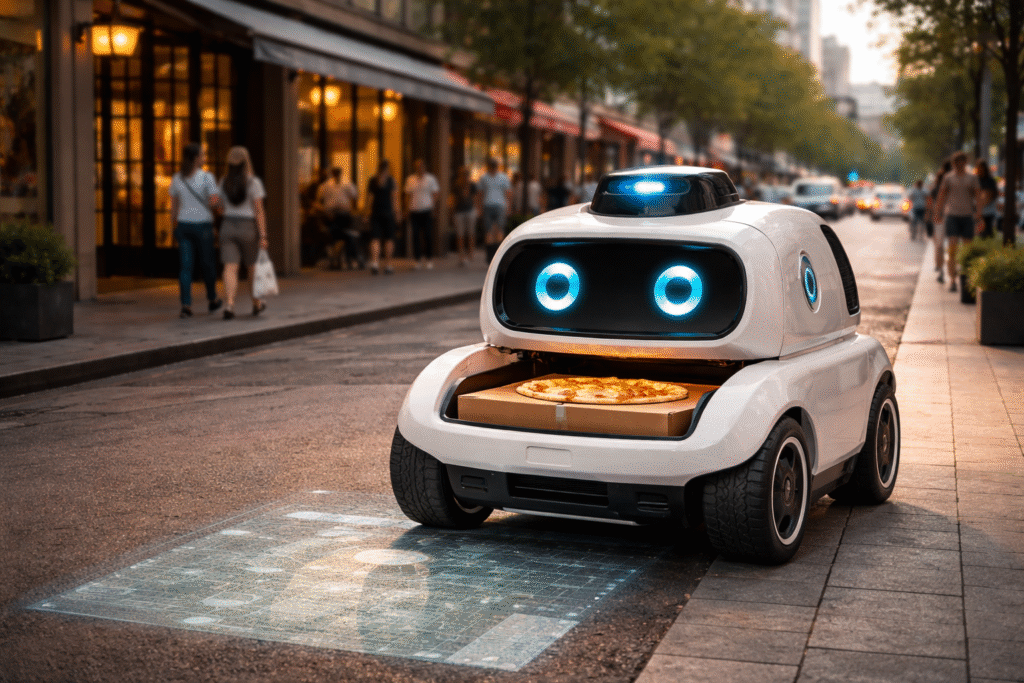
Delivery robots navigating real-world environments using visual data rather than relying only on GPS. Image credit: KorishTech (AI-generated).
Robot navigation is improving through human-generated data, as shown in how Pokémon Go data is now used to train delivery robots. MIT Technology Review reports that data collected through Pokémon Go is now being used to improve how delivery robots navigate real-world environments. Instead of relying only on GPS or pre-built maps, robots are being trained using a visual positioning system built from billions of images captured by players. This reflects a similar pattern seen in our previous analysis of the Anthropic AI labor report, where real-world usage—not theoretical capability—determines actual impact.
This represents a shift in how AI systems learn about the physical world. Rather than mapping environments directly, companies are increasingly using data generated through everyday human activity.
How Pokémon Go Data Is Used in Real Robots
The system is developed by Niantic Spatial, which builds a visual positioning system (VPS) using images and augmented reality scans collected from players over time.
More than 30 billion images and scans have been aggregated to construct a detailed visual map of real-world locations. These images capture buildings, streets, and landmarks from multiple angles, lighting conditions, and perspectives.
Delivery robots, such as those operated by Coco Robotics, use onboard cameras to capture their surroundings and compare them to this visual map. Instead of estimating their location within a few meters, the system allows robots to determine their position within centimetres.
This level of precision enables robots to navigate sidewalks, locate entrances, and complete deliveries more reliably.
Why Human Data Improves Robot Navigation
The effectiveness of this system comes from how the data is generated, fundamentally changing how robot navigation works in real-world environments.
Human movement naturally covers the same environments that delivery robots must operate in. Players walk along sidewalks, enter buildings, move through crowded areas, and interact with real-world obstacles.
As a result, the dataset captures:
- real walking paths rather than idealised routes
- varied perspectives and angles
- changing conditions such as lighting and weather
This creates a form of training data that is difficult to replicate in controlled environments. Instead of relying on predefined rules, AI systems learn from how humans move through space.
The result is not just more data, but more relevant data.
Why Traditional Robot Training Falls Short
Before systems like VPS, robots relied on a combination of GPS, sensors, and local mapping.
These approaches have clear limitations:
- GPS lacks precision in dense urban areas
- simulations fail to capture real-world complexity
- local mapping requires robots to learn environments from scratch
This makes navigation unreliable, especially in the final stages of delivery where accuracy matters most.
By contrast, a shared visual map built from human activity provides a starting point that already reflects real-world conditions.
Human Data vs Traditional Robot Training
| Training Method | Data Source | Strength | Limitation |
|---|---|---|---|
| Traditional (GPS / simulation) | Pre-built maps, synthetic environments | Scalable, controlled | Low real-world accuracy |
| Sensor-based (LiDAR / SLAM) | Robot-collected data | High precision locally | Expensive, limited coverage |
| Human-generated (VPS) | Player images and scans | Real-world, large-scale, adaptive | Dependent on data coverage |
This comparison highlights the shift from controlled data to behaviour-driven data.
What This Means for AI Development
This approach reflects a broader change in how AI systems are trained.
Instead of collecting data specifically for AI, companies are increasingly using data generated through existing platforms. Games, apps, and digital services become sources of real-world information.
This allows AI systems to improve continuously, without requiring dedicated data collection efforts.
In this case, a consumer game becomes part of the infrastructure supporting physical robotics.
The Hidden Trade-Off: Data and Awareness
The same mechanism that makes this system effective also raises questions.
The data used to build these systems is generated by users who may not be fully aware of how it will be applied. While data is typically aggregated and processed, the broader issue is how everyday activity becomes part of AI training systems.
This is not unique to gaming. Similar patterns appear in other areas where user behaviour feeds directly into system improvement.
My Take
This example shows that AI development is increasingly driven by how humans behave, rather than by how systems are manually designed.
The key shift is that data is no longer created specifically for AI training. Instead, AI systems learn from large volumes of existing human activity, such as movement, interaction, and decision patterns. In the case of VPS, this allows robots to understand real-world environments using information that was not originally collected for robotics.
This changes the speed at which AI can improve. When training data comes from continuous human activity, systems can evolve faster than traditional approaches that rely on curated datasets or controlled experiments.
The implication is not limited to robotics. Any domain where human behaviour generates structured or repeatable patterns can become a source of training data. This creates opportunities to improve systems in areas where building datasets manually would take significant time or resources.
The result is a shift in how progress happens. AI development becomes less dependent on isolated data collection and more dependent on how effectively human-generated data can be captured and used.
Sources
MIT Technology Review — How Pokémon Go is helping robots deliver pizza on time
https://www.technologyreview.com/2026/03/10/1134099/how-pokemon-go-is-helping-robots-deliver-pizza-on-time/
Niantic Spatial — Visual Positioning System (VPS)
https://www.nianticspatial.com/en/products/localize
Niantic Spatial — Coco Robotics partnership
https://www.nianticspatial.com/blog/coco-robotics