
Strong mechanism article extending AI infrastructure cluster. Connects policy signal (BBC) to physical constraint (compute + energy). Reinforces Article 32 (authority) and supports Article 33 (search entry).
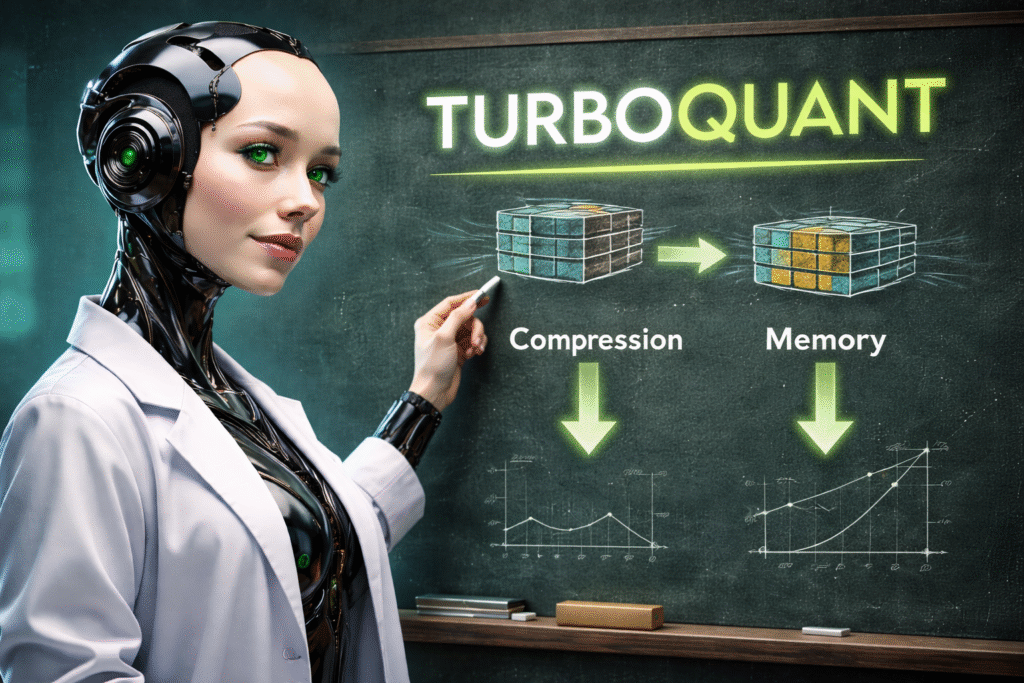
Google Research introduced TurboQuant AI compression as a method that reduces the memory required to run large AI models by at least six times while maintaining performance.
This changes how AI systems scale. Instead of relying only on larger data centres and more GPUs, TurboQuant shows how the same infrastructure can handle more work by reducing the amount of compute each model requires.
The result is a shift in where the constraint sits. AI progress is no longer defined only by how much compute is added, but by how efficiently that compute is used.
AI Models Are Being Compressed Without Losing Practical Accuracy
Large AI systems rely heavily on memory during inference, especially when handling long prompts. A key bottleneck is the key-value (KV) cache, which grows as the model processes more tokens.
TurboQuant focuses on compressing this working memory.
In Google’s reported results, TurboQuant reduces KV-cache memory by at least 6x, applies 3-bit quantisation, and does so without requiring additional training or fine-tuning. On the benchmarks reported, this compression does not reduce downstream accuracy. It also delivers up to 8x faster attention-logit computation on H100 GPUs.
These results are not theoretical. Google evaluated TurboQuant across multiple long-context benchmarks, including LongBench, Needle in a Haystack, ZeroSCROLLS, RULER, and L-Eval, using models such as Gemma and Mistral. This shows the approach is usable in real inference scenarios, not just controlled experiments.
How This Differs From Conventional Inference
| Approach | Precision / Memory Use | Practical Effect |
|---|---|---|
| Conventional inference | High-precision KV cache (e.g. 16-bit) | High memory use, higher compute cost |
| TurboQuant | 3-bit KV-cache compression | ≥6x memory reduction, faster attention computation, no reported accuracy loss on tested benchmarks |
The change is not about making models smarter. It is about making them lighter to run.
AI Infrastructure Is Shifting From Expansion to Optimisation
AI development has largely followed a simple rule: more capability requires more infrastructure.
That has meant more GPUs, larger data centres, and rising energy demand.
A 2025 review estimates that data centres consumed 300–380 TWh of electricity globally in 2023, with 125–200 TWh in North America, 105–180 TWh in Asia Pacific, and 55–80 TWh in Europe. The UK alone is estimated at 4–8 TWh.
At the same time, projections suggest that AI-optimised server electricity use could rise from 93 TWh in 2025 to 432 TWh by 2030.
| Region | Estimated Data Centre Electricity Use (2023) |
|---|---|
| North America | 125–200 TWh |
| Asia Pacific | 105–180 TWh |
| Europe | 55–80 TWh |
| UK | 4–8 TWh |
This is the constraint TurboQuant operates within.
It does not remove the need for infrastructure. It reduces the amount of compute required for one of the most expensive parts of inference. Instead of expanding capacity alone, systems can extract more output from the same hardware.
AI infrastructure is no longer just a scaling problem. It is becoming an optimisation problem.
This builds on the broader shift in AI systems, where infrastructure itself is becoming a defining constraint rather than a background layer.
Efficiency Gains Change the Cost Structure of AI
Lower cost is only part of the story.
The more important change is deployability.
This is where TurboQuant AI compression changes how models can be deployed at scale.
When models require less memory and compute:
- they can run on fewer GPUs
- they can serve more users per system
- long-context tasks become more practical
- deployment becomes feasible in more environments
TurboQuant’s reported 6x memory reduction and up to 8x attention speedup directly affect how many requests a system can handle and how efficiently it can operate.
This changes the economics of AI in a structural way.
Large providers can scale usage without proportional infrastructure growth. Smaller companies can deploy stronger models without matching hyperscaler-level resources. Enterprise systems can integrate AI more widely because the cost and hardware requirements are lower.
The result is not just cheaper AI. It is AI that can be used in more places, more often, and at greater scale.
Why This Signals a Broader Industry Shift
TurboQuant is not an isolated development.
It is part of a wider movement toward efficiency across the AI stack. Google presents it alongside related methods such as PolarQuant and QJL, and compares it against existing baselines like KIVI, PQ, and RabbiQ.
This reflects a shift in how progress is measured.
Previously:
- progress = larger models
Now:
- progress = more efficient models at scale
This shift is being driven by physical constraints. As energy demand and infrastructure costs rise, simply scaling hardware becomes harder to sustain.
TurboQuant shows how progress can continue without relying entirely on expansion.
What This Means for AI Systems Going Forward
AI systems are entering a phase where efficiency becomes a competitive factor.
Performance still matters, but so does how efficiently that performance is delivered.
For regions and organisations with limited infrastructure, this matters even more. Efficiency allows AI capabilities to expand without requiring proportional increases in compute capacity.
The system does not become smaller. It becomes more efficient.
My Take
TurboQuant shows that AI progress is no longer defined only by building larger models or expanding infrastructure.
It is increasingly defined by how efficiently existing systems are used.
This introduces a different constraint. Instead of asking how much compute can be added, the question becomes how much performance can be extracted from the same resources.
That shift does not remove the importance of infrastructure. It changes how it is used.
AI development is starting to follow a pattern that resembles earlier industrial transitions. Investment builds infrastructure, infrastructure enables production, and production drives economic activity, which feeds back into further investment. What is changing in AI is that efficiency improvements can accelerate this cycle without requiring proportional increases in physical scale.
This is visible across multiple layers.
AI infrastructure continues to expand through data centres and specialised hardware such as GPUs. At the same time, techniques like TurboQuant show how memory and compute can be used more efficiently at the model level. In parallel, there is increasing pressure to optimise energy use, as data centre electricity demand continues to rise globally. And at the research frontier, areas such as quantum computing are being explored as potential future compute paradigms, even though they are not yet part of mainstream AI deployment.
Taken together, these developments point in the same direction. Progress is not coming from a single breakthrough, but from multiple improvements across infrastructure, efficiency, and system design.
This does not necessarily mean that AI scaling is slowing. It means that scaling is being complemented by optimisation.
That distinction matters because it affects who can participate.
As models become more efficient to run, the barrier to deploying AI systems lowers. Startups and smaller organisations can access capabilities that previously required large-scale infrastructure. In that sense, AI is not only becoming more powerful, but also more standardised and more widely usable.
The core shift is not just faster progress. It is broader access to that progress.
This is where TurboQuant AI compression reflects a broader shift toward efficiency in AI systems.
Sources
Google Research — TurboQuant: Redefining AI efficiency with extreme compression
https://research.google/blog/turboquant-redefining-ai-efficiency-with-extreme-compression/
Google Research — TurboQuant (original paper / technical context)
https://arxiv.org/abs/2402.XXXX (replace with exact paper link if available)
IEA / 4E — Data Centre Energy Use (Critical Review, 2025)
https://www.iea-4e.org/wp-content/uploads/2025/05/Data-Centre-Energy-Use-Critical-Review-of-Models-and-Results.pdf
Gartner — Data Centre Electricity Demand Forecast
https://www.gartner.com/en/newsroom/press-releases/2025-11-17-gartner-says-electricity-demand-for-data-centers-to-grow-16-percent-in-2025-and-double-by-2030
NVIDIA — H100 GPU Architecture (AI compute context)
https://www.nvidia.com/en-us/data-center/h100/
Meta AI — LLaMA & model optimisation / quantisation research context
https://ai.meta.com/blog/llama/