
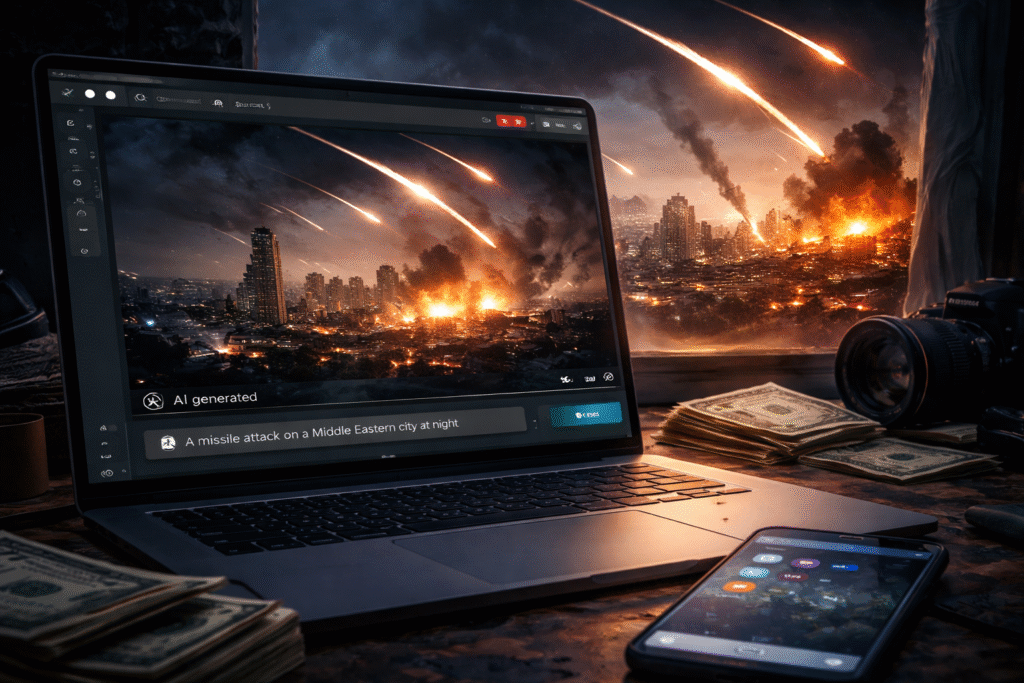
AI-generated illustration created for KorishTech.
AI-generated war videos showing missile strikes or explosions are increasingly spreading across social media during the Iran conflict.
Recent investigations by BBC Verify have found that AI-generated videos depicting strikes in the Iran–Israel conflict are spreading rapidly across social media platforms. Many of these clips appear dramatic and convincing at first glance: missile trails crossing dark skies, buildings exploding, and surveillance-style footage of nighttime attacks. In several cases, however, analysts later confirmed that the footage had been created using generative AI tools rather than recorded during real events.
The scale of distribution can be surprising. BBC researchers traced one synthetic missile-strike clip that appeared in more than 300 separate posts, gathering tens of thousands of engagements across multiple platforms. Other fabricated images and videos connected to the conflict have accumulated tens of millions of views before fact-checkers were able to debunk them.
The phenomenon reflects a structural shift in how wartime imagery can now be produced and circulated online.
For most of modern history, images of war required proximity to danger. Journalists, soldiers, or civilians had to physically witness an event before it could be recorded and shared. Generative AI removes that constraint. A creator can now produce convincing “war footage” from a laptop using a simple prompt — without ever being near the conflict itself.
When War Footage No Longer Requires a Battlefield
Historically, images of war were constrained by physical reality. Journalists, soldiers, or civilians had to be present to record events. Even propaganda required access to cameras, locations, or staged material.
Generative AI has changed that constraint. Modern text-to-image and text-to-video systems can create convincing scenes of missile attacks, burning cities, or military convoys within seconds. With simple prompts and editing software, a single creator can generate multiple clips that resemble breaking-news footage.
These videos are often edited to mimic familiar formats such as security camera recordings or smartphone footage. Sound effects and captions are added to increase realism. Once uploaded, the content spreads quickly through reposts and algorithmic recommendations.
As a result, scenes that appear to show specific battlefield events may in fact have no connection to reality at all.
Why AI-Generated War Videos Spread So Easily
The deeper issue is not only the technology that makes these videos possible. It is the incentive structure that rewards them.
Most large social media platforms distribute revenue to creators based on engagement metrics such as views, replies, or impressions. Under these systems, dramatic content tends to perform well because it attracts attention and emotional reactions.
According to reporting cited by BBC Verify, some platform executives have suggested that a large majority of accounts spreading AI-generated Iran war clips are doing so to exploit monetisation systems. Analysts estimate that certain creator-revenue programs can pay roughly $8–$12 per million impressions, meaning that widely shared clips can generate income if they accumulate enough views.
In other words, the combination of cheap AI production and engagement-driven monetisation creates a strong incentive to generate sensational war footage at scale.
The technology lowers the cost of making the content. The platform economy rewards its spread.
Why Misinformation in War Is Especially Dangerous
Fake or misleading images have appeared in wars for decades, but generative AI changes the scale and speed at which they can circulate.
Experts interviewed in investigations into AI-generated war media warn that synthetic clips can pollute the information environment during conflicts. When fabricated footage spreads widely, it becomes harder for viewers to distinguish between authentic reporting and staged content.
One concern is that repeated exposure to convincing but false material can gradually erode trust in real documentation from war zones. Technology companies are already experimenting with ways to address this problem, including systems designed to help prove whether content is authentic or AI-generated.
This problem has consequences beyond social media. In conflicts, verified footage can influence international opinion, humanitarian responses, and investigations into potential war crimes. When the information space becomes saturated with fabricated imagery, establishing a shared understanding of events becomes much harder.
How Fact-Checkers Identify Synthetic War Footage
Verification teams such as BBC Verify rely on a combination of techniques to analyse suspicious videos.
Visual analysis can reveal subtle artefacts common in AI-generated imagery, including inconsistent lighting, distorted objects, or unnatural motion patterns. Analysts also compare footage with satellite imagery, geolocation clues, and eyewitness reports to determine whether a claimed event actually occurred.
In some cases, the same synthetic clip appears repeatedly across different accounts, sometimes with altered captions describing different locations or attacks. When investigators trace the origins of these clips, they often find no evidence that the depicted events ever happened.
These methods can be effective when professional teams examine the material carefully. But the scale of online content means that most viewers encounter such videos long before verification takes place.
The Emerging “Fog of War 2.0”
The Iran–Israel conflict is not the first war in which misleading visuals have circulated online, but it may be one of the earliest conflicts where generative AI content is systematically monetised by creators.
The result is an evolving information environment where dramatic imagery can be produced endlessly and distributed globally within minutes. Real footage from the battlefield now competes with synthetic content that may be easier to create and more emotionally provocative.
Generative AI did not invent misinformation. But it has lowered the cost of producing it while platforms continue to reward attention and engagement.
Together, those forces are reshaping the digital “fog of war,” making it increasingly difficult to determine what images of conflict actually represent.
My Take
Generative AI imagery in wartime environments may become a serious social challenge if it continues to scale without meaningful safeguards.
As this article shows, the combination of cheap AI generation and engagement-driven monetisation allows misleading images or videos to spread rapidly across platforms. The result is not just misinformation, but the gradual erosion of trust in legitimate reporting. When people begin to doubt all visual evidence, even authentic documentation from conflict zones becomes harder to verify.
Warnings about technological risks to society are not new. In 2015, Bill Gates argued that the world was underprepared for global pandemics, highlighting how societies often underestimate emerging systemic threats. His broader point was that new risks can grow quietly until a crisis exposes how unprepared institutions really are.
A similar vulnerability may now be developing in the information environment. Generative AI dramatically lowers the cost of producing convincing imagery, including fabricated scenes of violence or military activity.
When such material spreads widely online, it can unintentionally reinforce propaganda narratives or deepen political divisions.
Addressing this challenge will likely require more than voluntary action by technology companies. Platforms face a structural tension between engagement incentives and information integrity, and many have not yet demonstrated that they can fully resolve that conflict on their own.
Regulatory responses are beginning to emerge in some regions — particularly within the European Union — but global coordination remains limited. If synthetic media continues to scale at the current pace, governments, platforms, and AI developers may need clearer standards for transparency, labelling, and accountability.
At the same time, generative AI itself is not inherently harmful. These tools have already made advanced creative techniques more accessible and enabled new forms of storytelling and communication. The challenge is ensuring that their benefits are realised without allowing misleading or manipulative content to undermine public trust.
In conflicts especially, where accurate information can shape diplomacy, humanitarian response, and the historical record, the reliability of visual evidence remains critical. Preventing the uncontrolled spread of deceptive synthetic media may therefore become an important task not only for technology companies, but also for governments, journalists, and the public.
Sources
BBC Verify — AI-generated Iran war videos surge as creators use new tech to cash in
https://www.bbc.com/news/articles/ckg8wvz427vo
BBC News — Israel-Iran conflict unleashes wave of AI disinformation
https://www.bbc.com/news/articles/c0k78715enxo
University College Cork — First ever study of wartime deepfakes reveals their impact on news media
https://www.ucc.ie/en/news/2023/first-ever-study-of-wartime-deepfakes-reveals-their-impact-on-news-media-.html
Cristian Vaccari & Andrew Chadwick — Deepfakes and Disinformation: Exploring the Impact of Synthetic Political Video on Deception, Uncertainty, and Trust in News
https://journals.sagepub.com/doi/10.1177/2056305120903408
CBC News — This TikTok account pumped out fake war footage with AI — until CBC investigated
https://www.cbc.ca/news/canada/ai-slop-ukraine-misinformation-1.7407773