
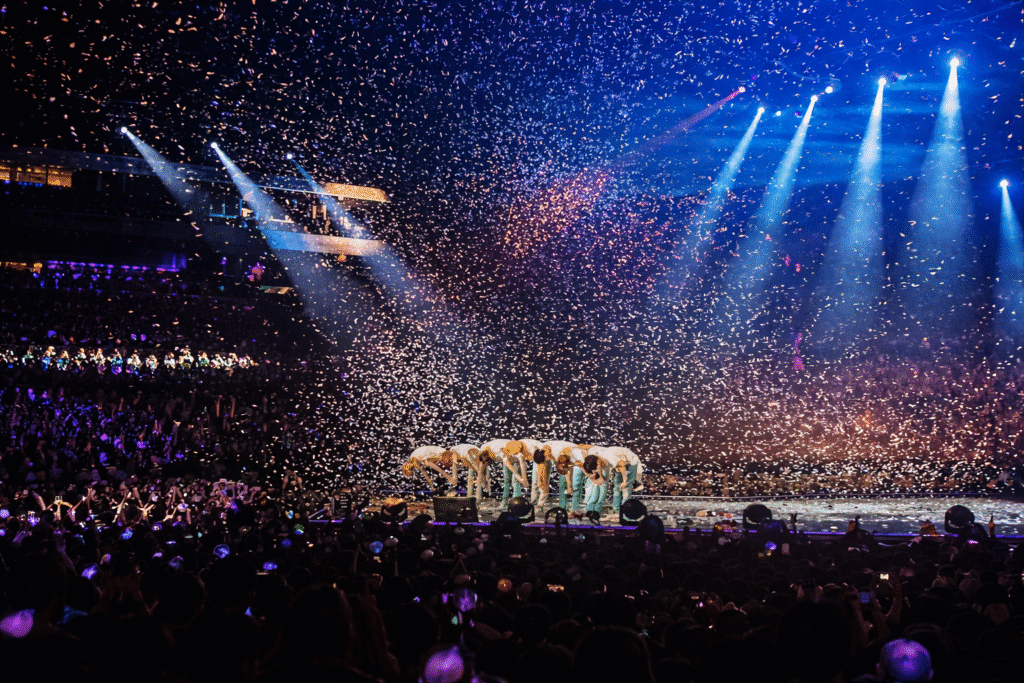
Global streaming infrastructure allows a single concert to reach millions of viewers simultaneously. Image credit: KorishTech (AI-generated).
The BTS Netflix concert 18.4 million viewers milestone is not what this story is about. What matters here is a specific event: BTS’s comeback concert, streamed live on Netflix, reached 18.4 million viewers globally. That number did not come from a larger stadium, better visuals, or more advanced stage technology. It came from how the concert was distributed.
The performance took place in Seoul Olympic Stadium, a venue that physically holds tens of thousands of people. Yet the audience reached into the millions, across more than 190 countries. The gap between those two numbers is not explained by the concert itself. It is explained by the system that delivered it.
The 18.4 Million Viewers Was Not a Stadium Number
The BTS Netflix concert 18.4 million viewers figure reflects Netflix’s “Live+1” metric — the average number of viewers per minute during the live event window, including those who watched within one hour after. This is not a peak moment or a cumulative total over days. It represents sustained, simultaneous global attention.
That scale cannot be achieved through physical expansion. Even the largest stadiums cap at around 100,000 attendees. The difference between tens of thousands and millions is not incremental. It is structural.
What changed is not how concerts are performed, but how they are delivered.
Global Streaming Works by Distributing, Not Broadcasting
A common assumption is that a live stream is sent from a central server to everyone watching. At small scale, that model works. At global scale, it fails almost immediately.
Netflix does not rely on a single origin point. Instead, it uses a distributed system called Open Connect — a content delivery network built specifically to move video efficiently across the internet. Rather than pushing the stream from one location, the system places copies of the content closer to users.
This is not a minor optimisation. It is the difference between a system collapsing under load and one that scales with demand.
The Same Concert Is Delivered Locally Everywhere
The key mechanism is localisation.
Netflix deploys thousands of servers, known as Open Connect Appliances, directly inside internet service provider networks around the world. When a user presses play, the stream is not coming from Korea or a distant data centre. It is coming from a nearby node within their region.
This means:
- The same live feed is replicated across the network
- Users are served from the nearest available location
- Traffic is distributed rather than concentrated
As a result, millions of viewers are not competing for a single stream. They are each receiving it locally, at the same time.
Scale Comes From Splitting Demand Across the Network
The challenge of a global live event is not creating the content. It is handling simultaneous demand.
In practice, this means the system does not grow by becoming more powerful at a single point. It grows by spreading demand across many locations at once. Each additional node reduces pressure on the overall system, allowing millions of viewers to join without affecting stability. This is what makes global streaming fundamentally different from traditional broadcast systems.
If all 18.4 million viewers had to pull data from one source, the system would fail due to bandwidth limits, latency, and congestion. By distributing the load across thousands of edge locations, Netflix avoids this bottleneck entirely.
Each local server handles a fraction of the total audience. Together, they form a system that can scale horizontally — adding capacity by adding more nodes, not by increasing pressure on a central system.
This is why the experience remains stable even at massive scale. The infrastructure absorbs the demand instead of concentrating it.
The System Works Because It Is Distributed, Not Intelligent
AI does exist within Netflix’s broader system. It is used to optimise video encoding, recommend content to users, and predict traffic patterns. These functions improve efficiency and discovery. For a clearer explanation of how infrastructure systems operate continuously in real-world environments, see What Is AI Infrastructure and Why Does It Matter?.
However, they do not explain the core outcome.
The ability to deliver a live concert to millions of viewers at the same time depends on deterministic infrastructure: ingestion, encoding, segmentation, and distribution through a global network. AI supports this system, but it does not replace it.
The scale comes from how the content is distributed, not how it is optimised.
Why Audience Size Is No Longer Limited by Venue Capacity
For artists and producers, the constraint of venue capacity becomes less relevant. A concert is no longer limited by physical attendance.
For platforms like Netflix, live events become a new category of content — one that combines the immediacy of broadcast with the reach of on-demand streaming.
For audiences, access becomes independent of geography. Attending a global event no longer requires being in the same place.
Why Future Concerts Will Be Designed for Distribution First
As streaming infrastructure continues to mature, more live events will follow this model. The distinction between “live broadcast” and “streaming release” will continue to blur.
The competitive edge will not come from who can produce the most elaborate show, but from who can deliver it reliably at global scale.
This shifts investment away from the stage and toward the network.
My Take
The success of the BTS concert on Netflix came from a well-structured streaming system, not from AI.
The BTS Netflix concert 18.4 million viewers milestone highlights how scale is driven by distribution, not production.
What made 18.4 million viewers possible was the ability to distribute the same live event globally without overloading a central system. That is an infrastructure problem, and Netflix solved it through distribution.
AI may still play a growing role around this system. It can improve video quality, optimise delivery, and enable features such as real-time subtitles or translation for global audiences. These capabilities are already developing, but they do not determine scale on their own.
The shift is not that AI replaces streaming infrastructure, but that it builds on top of it. Just as factories changed how things were produced, infrastructure changed how content is delivered. AI is more likely to expand what that infrastructure can do rather than redefine it entirely.
Sources
BTS comeback concert draws 18.4 million viewers on Netflix
https://www.bbc.com/news/articles/cy513rvg91ro
Netflix Open Connect — Content Delivery Network Infrastructure
https://openconnect.netflix.com
Pingback: BTS Concert Light Stick System — How Fans Become the Show | KorishTech