
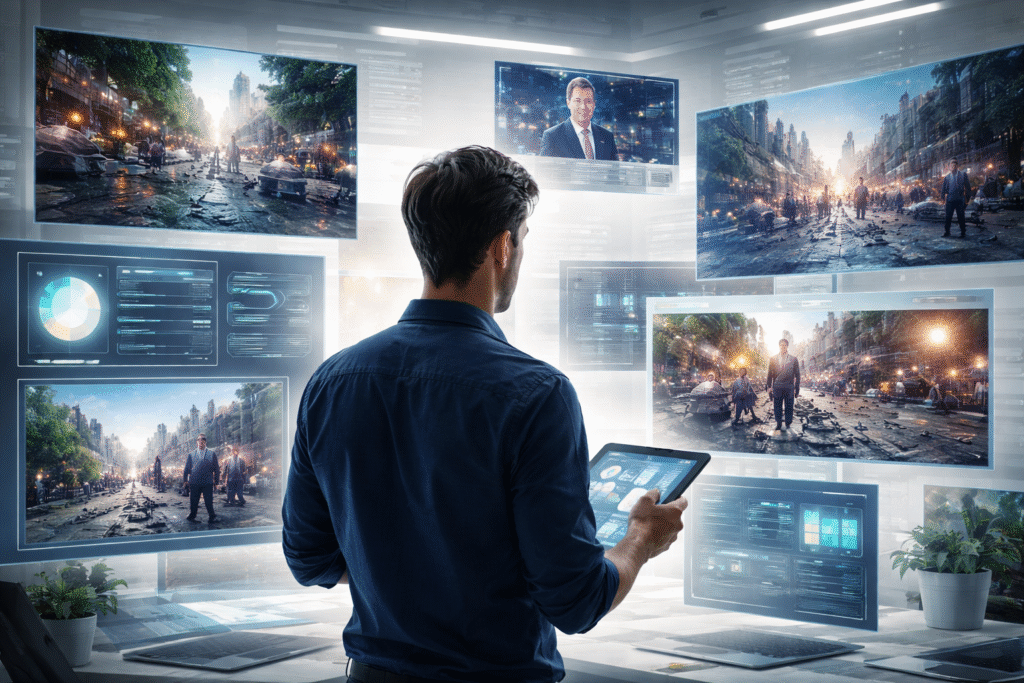
Conceptual illustration representing the challenge of verifying whether digital images or videos are real or AI-generated. Image credit: AI-generated illustration created for KorishTech.
AI-generated images and videos have spread rapidly since 2023 as generative tools became widely accessible to the public. At the same time, verifying whether a piece of media is real has become significantly more difficult.
The result is a growing gap between how easily synthetic media can be produced and how difficult it is to verify its authenticity. Understanding how detection works today is becoming increasingly important for journalists, researchers, and the public.
The Rapid Rise of Synthetic Media
The growth of generative AI tools has dramatically changed how visual content is created online.
Modern image and video models can now produce highly realistic scenes from simple text prompts, allowing anyone to create convincing AI-generated images or video clips within seconds. Many of these tools are embedded directly into consumer applications, allowing anyone with a smartphone to generate convincing images or video clips within seconds.
This accessibility has led to a sharp increase in synthetic media circulating on social platforms.
Several industry analyses highlight the scale of the shift:
- Deepfake files reportedly grew from around 500,000 in 2023 to a projected 8 million by 2025.
- Some datasets estimate a 550% increase in deepfake videos since 2019.
- Fraud attempts using deepfake media reportedly increased by about 3,000% in 2023.
These figures do not capture the full volume of AI-generated imagery circulating casually on social media, but they illustrate the rapid acceleration of synthetic media production.
Real-world events have also shown how quickly such material can spread. During recent conflicts, including the Israel–Hamas war, AI-generated images depicting fabricated battlefield scenes circulated widely online before being debunked by journalists and investigators. Similar concerns about synthetic media risks also appeared during the Grok image safety incident.
Why Detecting AI Media Is So Difficult
The difficulty of detecting AI-generated media stems from a basic asymmetry: generation requires only one convincing output, while verification requires multiple layers of analysis.
A generative model only needs to produce a single realistic image or clip that appears plausible. Verification, by contrast, must examine whether the media might be synthetic, edited, miscaptioned, or taken from another time or location.
This imbalance is made worse by several technical factors.
Generative models continue to improve rapidly, reducing the visual artifacts that earlier detection tools relied on. Meanwhile, most online platforms compress images and videos when they are uploaded, which removes subtle pixel-level signals that forensic tools sometimes use to identify manipulation.
Another challenge is the absence of universal watermark standards. Some companies now embed digital markers in AI-generated media, but many models — especially open-source systems — produce files without such signals.
Attackers can also deliberately design content to evade detection tools. By slightly altering images or re-encoding video files, they can remove metadata, disrupt watermarks, or bypass automated detectors.
As a result, identifying synthetic media increasingly requires a combination of techniques rather than a single reliable method.
How AI-Generated Images Are Detected in 2026
Today’s verification workflows typically combine several technical and investigative approaches.
| Detection Method | What It Looks For | Limitations |
|---|---|---|
| Visual artifact analysis | Inconsistent lighting, unnatural facial movements, distorted hands or textures | New models increasingly remove these artifacts |
| Metadata inspection | Camera data, timestamps, editing software tags | Metadata can be removed or altered |
| Reverse image search | Earlier appearances of the same image or frames | Ineffective if the media is entirely synthetic |
| Watermarks & provenance | Hidden signals or signed records such as C2PA content credentials | Not all AI systems embed these markers |
| AI detection tools | Machine-learning models that classify images or video as synthetic | Detectors must constantly update to track new models |
In practice, analysts rarely rely on a single method. Instead, they combine these signals to build confidence about whether a piece of media is authentic.
Tools Used to Detect Synthetic Media
A growing ecosystem of detection tools attempts to automate this process.
Several platforms provide AI-generated content detection services:
- Hive AI offers multi-modal detection across images, audio, and video.
- AI or Not analyzes uploaded images and returns a probability score for synthetic content.
- Reality Defender focuses on enterprise-level detection of voice and video impersonation.
- Sensity monitors deepfake activity across online platforms.
- Deepware provides analysis tools focused on face-swap videos.
Alongside these detectors, several technology initiatives are trying to make AI-generated media easier to trace.
Google’s SynthID embeds imperceptible watermarks into AI-generated images or text. Meanwhile, the Content Credentials system developed under the C2PA standard allows creators and platforms to attach cryptographically signed records showing how a piece of media was created or edited.
These systems represent a shift away from trying to detect fakes purely through visual analysis and toward verifying where media originated and how it was produced.
How Journalists Verify Images and Videos
Professional investigators typically use a broader verification process that goes beyond automated detection tools.
Organizations such as BBC Verify and Bellingcat use open-source intelligence methods to analyze suspicious media.
Their process often begins with three core questions: where, when, and why the footage was recorded.
Analysts examine visible clues such as road signs, building shapes, terrain features, or weather conditions. These details are compared against satellite imagery and historical weather data to determine whether the location and time match the claims attached to the media.
Reverse image searches are also used to identify whether the same visuals appeared previously in a different context.
Rather than relying solely on AI detection tools, investigators treat those tools as one signal among many. Final conclusions typically require multiple forms of evidence.
The Emerging Arms Race Between Generation and Detection
Experts increasingly describe synthetic media verification as an ongoing technological arms race.
Generative models continue to improve in realism, while detection systems must constantly adapt to new architectures and techniques. At the same time, attackers can generate thousands of variations of a fake image or video, overwhelming verification systems that still rely heavily on manual analysis.
Because of this imbalance, many researchers believe that the future of media verification will depend less on detecting fakes after they appear and more on establishing trusted provenance systems that confirm authentic content from the moment it is created.
Technologies such as C2PA content credentials are early attempts to build such systems, but their effectiveness will depend on widespread adoption across platforms, tools, and governments.
For now, the ability to critically evaluate digital media remains an essential skill.
My Take
The deeper issue behind synthetic media is not simply that AI can generate convincing images or videos. It is that the systems used to verify information were designed for a much slower information environment.
In the past, misleading images might circulate occasionally and could be investigated by journalists or fact-checkers. Today, AI tools allow large volumes of synthetic content to be produced instantly and spread globally through social networks before verification even begins.
Until reliable systems exist to confirm whether images or videos are AI-generated, the public will continue to face a high risk of misleading information. Human perception alone is not reliable enough to distinguish authentic content from synthetic media, especially as generative models become more realistic.
One possible response is stronger support for verification technologies. Governments may eventually need to fund research and development for AI detection tools in the same way they support cybersecurity infrastructure. If generative AI continues to advance rapidly, detection and verification capabilities will likely need to evolve alongside it.
There is unlikely to be a single perfect solution to this challenge. The more realistic path will probably involve a combination of improved verification technologies, stronger provenance standards, and greater public awareness of how easily digital media can now be manipulated.
Sources
BBC Verify
https://gotranscript.com/public/bbc-explains-how-it-verifies-viral-news-videos
C2PA Content Credentials
https://spec.c2pa.org/post/contentcredentials/
Deepfake statistics overview
https://keepnetlabs.com/blog/deepfake-statistics-and-trends/
AI detection tools overview
https://www.aiornot.com/blog/deepfake-detection-tools/
Pingback: AI Music Fraud: How Streaming Platforms Were Manipulated at Scale | KorishTech