
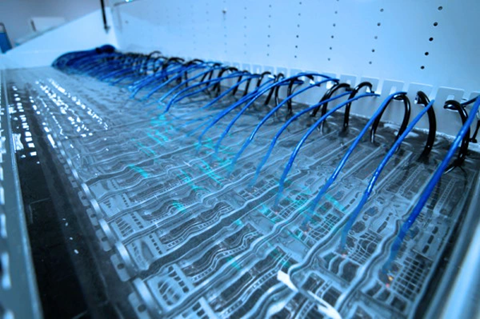
Liquid-cooled GPU racks inside a hyperscale data centre, designed to manage the heat generated by dense AI workloads.
Image credit: Newtech Group — Immersion & Liquid Cooling for Data Centers (https://www.newtechapac.com/immersion-cooling/)
What people are noticing now
The AI boom is no longer abstract. It is materialising as concrete, steel, cables, and cooling pipes.
Around the world, a new class of infrastructure is expanding at speed: hyperscale AI data centres. These facilities are designed to train and run large AI models by bundling hundreds of thousands of specialised chips into tightly synchronised systems that behave like a single supercomputer. The architecture is new, powerful — and physically demanding.
The primary signal is scale. The largest data centres now being planned can draw hundreds of megawatts, with some approaching one gigawatt of electricity — roughly the consumption of a mid-sized city. Cooling those machines has become so difficult that traditional air-conditioning is often no longer sufficient. Instead, chips are mounted on cold-water plates, submerged in specialised fluids, or cooled using increasingly experimental techniques.
This is the backdrop to growing public concern. Communities hosting these facilities are grappling with rising energy demand, water use, noise, and questions about who ultimately pays for the infrastructure required to support AI at this scale.
What hyperscale AI data centres actually are — and why they are different
A data centre, at its simplest, is a facility that houses computing equipment — servers, storage, and networking — alongside the power, cooling, and security systems needed to run them reliably.
Hyperscale AI data centres are a distinct category. They are optimised not for general web services alone, but for AI training and inference at massive scale. Instead of thousands of conventional servers, they concentrate tens — sometimes hundreds — of thousands of graphics processing units (GPUs) or AI accelerators in a single campus.
These chips excel at parallel computation. When linked together with high-speed networking, they can process enormous datasets and train large models far faster than traditional systems. The result is an architecture that resembles one giant machine rather than a collection of independent computers.
The economic logic pushes toward size. AI workloads reward scale: larger clusters reduce training time, improve utilisation, and justify the immense capital cost of specialised hardware and networking. That is why growth is concentrating into fewer, much larger facilities.
To give readers a clearer sense of how quickly that scale is changing, it helps to anchor the trend with a few concrete numbers:
| Indicator | Around 2015 | 2023–2024 | Direction to 2030 |
|---|---|---|---|
| Global data centre share of electricity | ~1% | ~2% | ~3–4% (projections) |
| Global data centre electricity use | ~200 TWh | ~350–500 TWh (estimated) | Up to ~900 TWh in high-AI scenarios |
| Typical hyperscale site power draw | 30–60 MW | 100–300 MW | Larger campuses dominate |
| Largest planned AI campuses | Rare | 600 MW–1 GW | Becoming more common |
| Typical rack density | 10–15 kW | 30–50 kW | 50–100+ kW for AI |
| Cooling share of facility energy | ~20–25% | ~30–40% | Cooling becomes a primary constraint |
The breakthrough architecture — and why it consumes so much power
The core technical breakthrough behind hyperscale AI data centres is coordination.
Modern facilities combine several tightly coupled layers:
- Compute: vast clusters of GPUs such as Nvidia’s H100-class accelerators, designed for parallel AI workloads.
- Networking: high-bandwidth, low-latency fibre-optic fabrics that connect chips like a nervous system, allowing them to work in lockstep.
- Storage: distributed, high-performance systems to feed training data and store intermediate model states.
- Power infrastructure: high-voltage grid connections, substations, uninterruptible power supplies, backup generation, and increasingly battery storage.
- Cooling: advanced systems to remove heat from densely packed chips operating continuously at high load.
This design enables unprecedented AI capability — but it also concentrates energy use. AI accelerators run hot, and as rack densities rise, the energy needed just to keep systems within safe operating temperatures becomes a dominant factor in total consumption.
Industry analyses suggest that cooling alone can account for 30–40% of total facility energy use in some designs. Even where liquid cooling improves efficiency, total electricity demand continues to rise because the underlying compute load is growing faster.
From air to liquid: how cooling became the constraint
For decades, data centres relied primarily on air cooling. Cool air flowed through server racks, absorbed heat, and was expelled and chilled again. This model works well at moderate power densities.
AI changed that balance.
Modern AI racks can exceed 50–100 kilowatts per rack, well beyond what air systems can efficiently manage. As a result, operators are shifting rapidly toward liquid-based cooling:
- Direct-to-chip cooling: liquid circulates through cold plates attached directly to CPUs and GPUs, removing heat at the source.
- Immersion cooling: entire servers are submerged in non-conductive fluids that absorb and transfer heat extremely efficiently.
- Hybrid systems: combining liquid cooling for high-density AI racks with advanced air cooling elsewhere.
Liquid cooling can reduce energy overhead and enable higher performance, but it introduces new complexity: plumbing, leak detection, fluid management, and in some cases higher operational skill requirements. In water-scarce regions, even efficient systems raise questions about long-term sustainability.
The fact that some proposals now discuss seawater cooling or even space-based solar power reflects how close current designs are to physical limits on land.
The scale of growth — and why it matters
Globally, data centres already consume around 1–2% of total electricity demand. Recent analyses suggest that AI-driven growth could push this significantly higher by the end of the decade.
In the United States alone, data centres accounted for over 4% of national electricity consumption in 2023, up sharply from previous estimates. The largest hyperscale AI sites now under development approach or exceed city-scale demand.
This growth is not limited to AI companies. Cloud computing, streaming media, telecommunications, finance, and public digital services all depend on data centre capacity. AI accelerates the trend, but it does not create it from nothing.
The issue, increasingly, is not whether data centres are useful — it is how their costs and benefits are distributed.
Who this affects first: communities, grids, and workers
For local communities, the impact is tangible. Large data centres can bring construction activity, skilled jobs, and tax revenue. At the same time, residents often face higher electricity demand on local grids, competition for water resources, constant background noise from cooling and backup systems, and concerns about air quality from generators.
Utilities and regulators face a different challenge. Connecting a single hyperscale site can require years of grid upgrades, new transmission lines, and generation capacity. If those costs are socialised, households and small businesses may bear part of the burden.
For workers and the broader economy, the picture is mixed but significant. Data centres support high-skill technical roles, construction jobs, and an ecosystem of suppliers. They also underpin digital industries far beyond AI, from fintech to public services.
Ireland and the UAE: two paths through the same problem
The tension between growth and physical limits becomes clearest when comparing national responses.
Ireland: success forcing a reset
Ireland became one of Europe’s major data centre hubs over the past decade. Concentration around Dublin brought investment and digital capability — but also strain. By the early 2020s, data centres were consuming nearly a quarter of Ireland’s electricity, more than all urban households combined.
Grid stress and climate commitments forced intervention. Regulators effectively paused new connections in constrained regions and, by late 2025, introduced a new framework. Under the updated rules, new large data centres must:
- Provide or contract dispatchable generation or storage to meet their demand.
- Source around 80% of annual electricity from additional renewable projects within defined timeframes.
- Be capable of supporting grid stability rather than simply drawing from it.
Ireland’s approach reframes data centres as energy system participants, not passive consumers.
UAE and Dubai: infrastructure as national strategy
The UAE, and Dubai in particular, present a contrasting model. There, hyperscale data centres are positioned as part of a state-backed push to become a global AI and cloud hub. Large investments, sovereign capital, and partnerships with global technology firms aim to attract AI workloads serving the Middle East, Africa, and beyond.
The benefits are clear: industrial diversification, high-skill jobs, and strategic digital capacity. The constraints are equally real. Power demand in hot climates, water scarcity, and dependence on imported advanced chips and intellectual property all pose risks.
Both cases show the same underlying reality: hyperscale AI infrastructure forces countries to confront physical limits directly, whether through regulation or state planning.
How governments are responding more broadly
Across regions, data centres are increasingly treated as critical national infrastructure.
In the European Union, policy is pushing toward climate-neutral, energy-efficient facilities by 2030, backed by reporting obligations and efficiency standards. Germany’s Energy Efficiency Act, for example, sets strict requirements for power usage effectiveness and energy reuse in new data centres after 2026.
In the United States, policy remains fragmented, but many states are introducing legislation to protect ratepayers, create special tariffs for large data centres, and align growth with climate goals.
In the United Kingdom, data centres have been formally recognised as critical infrastructure, bringing new security, resilience, and planning frameworks for very large projects.
The common thread is acknowledgement: AI infrastructure is no longer “just IT”. It is part of the energy, water, and industrial system.
What this signals next
Hyperscale AI data centres are becoming the factories of the AI era. Like the mills and power plants of the industrial revolution, they enable enormous productivity gains — but only by drawing heavily on physical resources.
The next phase of AI growth will likely be shaped less by algorithmic breakthroughs than by engineering advances in power generation, cooling, materials, and systems design, alongside clearer governance frameworks. Efficiency gains will matter, but they may not fully offset rising demand.
The question facing governments and companies is not whether to build these facilities, but how to do so without shifting disproportionate costs onto communities or undermining climate and water goals.
My Take
Building large numbers of data centres around the world is foundational to establishing an AI era, much as factories and power infrastructure were to the industrial revolution. At the same time, it is now evident that data centres bring both advantages and disadvantages, along with real risks around energy, water, and safety.
This moment also represents an opportunity. Companies and countries can expand their AI industries while cooperating at a national and international level to create economic synergies and shared standards. The key constraint highlighted across all serious analyses is physical limitation — power, cooling, land, and water.
Finding solutions to these limits will not only shape the future of AI, but also drive advances in engineering, physics, and materials science that extend well beyond the data centre itself.
Sources
Primary source
- Michelle Kim, Hyperscale AI data centers: 10 Breakthrough Technologies 2026 (12 Jan 2026)
Selected supporting and authoritative sources
- International Energy Agency — Energy and AI
https://www.iea.org/reports/energy-and-ai/energy-demand-from-ai - CRU (Ireland) — Large Energy Users Connection Policy
https://www.cru.ie/about-us/news/new-electricity-connection-policy-for-data-centre/ - Irish Times — Ireland’s data centre electricity share and new rules
https://www.irishtimes.com/business/2025/12/12/new-data-centres-must-generate-and-supply-electricity-to-wider-market-regulator-rules/ - ScienceDirect — Next-generation cooling technologies for AI data centres
https://www.sciencedirect.com/science/article/pii/S221313882500342X
Pingback: AI Infrastructure: What Gartner’s Predictions Reveal About the Future