
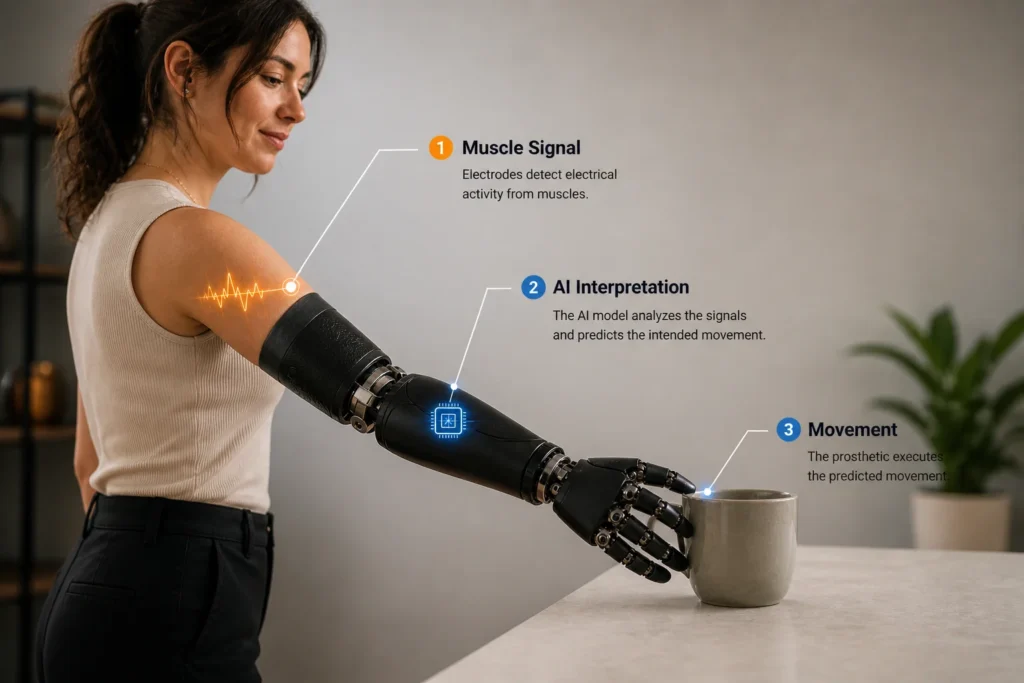
AI prosthetic arms convert muscle signals into movement through interpretation, not direct control. Image credit: KorishTech (AI-generated)
An AI prosthetic arm does not move because it knows what the user wants.
It moves because it makes a decision.
The system receives electrical signals from the user’s muscles, compares them to patterns it has learned, and selects the movement that best matches those signals. That selection is then executed as a physical action.
The prosthetic arm is not following a clear instruction.
It is interpreting a signal and acting on a prediction.
This is how an AI prosthetic arm turns muscle signals into movement.
How an AI Prosthetic Arm Reads Muscle Signals
The starting point is electromyography, or EMG.
Electrodes placed on the residual limb detect small voltage changes produced when muscle fibres activate. These signals are the electrical trace of muscle activity — the body’s attempt to move.
They are not commands.
They do not contain clear labels such as “open hand” or “rotate wrist.” Instead, they reflect how groups of muscles are firing at a given moment. What the system receives is a pattern of electrical activity, not a direct expression of intent.
This matters because the system never sees intention itself. It only sees the physical signal that results from it.
The entire system is built around translating that signal into action.
Muscle Signals Are Noisy, Not Clean Commands
If those signals were stable, the problem would be simpler.
They are not.
The same intended movement does not produce the same signal every time. Muscle fatigue changes how fibres activate. Electrodes shift slightly during use. Sweat and skin impedance affect signal quality. Nearby muscles introduce interference.
As a result, the input is inconsistent.
A single intention can produce multiple different signal patterns across time. At the same time, different movements can sometimes generate similar patterns, especially when signals overlap or degrade.
This creates ambiguity.
The system is not translating a fixed command. It is deciding between possibilities based on incomplete and changing data. Each signal must be interpreted in context, not simply decoded.
That is where uncertainty enters the system.
The AI Learns Patterns, Not Meaning
To manage this ambiguity, the system relies on pattern recognition.
During training, the user performs or attempts specific movements while the system records the corresponding EMG signals. Each signal pattern is labelled with the intended action.
Over time, the model builds a mapping between signal patterns and movement classes.
When a new signal arrives, the system extracts features from it — such as amplitude, timing, and waveform characteristics — and compares those features to patterns it has seen before. It then selects the movement that most closely matches the current signal.
This process is statistical.
The system does not understand the action. It does not confirm intention. It selects the most probable match based on past data.
This is the same logic that underpins text-based AI, but here the output is not a sentence.
It is a movement.
Prediction Becomes Movement
Once a movement is selected, the system acts immediately.
The classification result is translated into a control instruction. That instruction is passed to a controller, which drives motors and actuators within the prosthetic arm.
Fingers open or close. A wrist rotates. A grip tightens.
At this point, the prediction becomes physical force.
In an AI prosthetic arm, this prediction directly controls movement.
This is where these systems diverge from digital AI. In text-based systems, a wrong prediction produces an incorrect word that can be ignored or corrected. In a physical system, a wrong prediction produces an incorrect movement.
This is the same pattern seen in why AI answers feel right, where systems produce outputs that feel correct before they are verified.
The difference is not technical. It is practical.
An incorrect word is visible. An incorrect movement changes the environment.
The Arm Has to Learn the User
Performance is not stable at the beginning.
Each user produces unique signal patterns, shaped by their physiology, muscle condition, and movement habits. The system must adapt to those patterns through training.
During calibration, the user repeats specific actions so the model can associate signal patterns with intended movements. Over time, frequently used actions become easier to recognise. The mapping becomes more personalised.
But this adaptation is not one-sided.
The user also adjusts. They learn how to produce clearer or more consistent signals, sometimes modifying how they attempt movements to achieve better control.
Control becomes a shared process.
The system learns the user, and the user learns the system.
Even with adaptation, variability remains. The system becomes more reliable, but never fully deterministic.
The Hard Part Is Interpretation, Not Movement
The mechanical side of the system is relatively mature.
Motors can generate precise movement. Actuators can execute commands reliably. The physical hardware is capable of performing the required actions.
The difficulty lies earlier in the pipeline.
The system must decide which movement should occur, based on signals that are incomplete and variable. This decision is made under uncertainty.
This is the core limitation of any AI prosthetic arm system.
The prosthetic arm is effective because it can interpret signals.
It is limited because those signals are not always clear.
If you’ve seen how machine learning systems behave in other contexts, this pattern is familiar: the system selects the most probable outcome, not a guaranteed one.
When Interpretation Fails, Movement Fails
Failure in this system is direct and visible.
If the model confuses similar signal patterns, it may select the wrong action. A hand may open instead of closing. A grip may weaken at the wrong moment. A movement may be delayed or triggered too early.
These are not abstract errors.
They affect real tasks: holding objects, performing daily routines, interacting with the environment. When errors occur, the user often has to stop, reset, or repeat the action.
Over time, factors such as fatigue, electrode movement, or environmental conditions can degrade performance. Accuracy achieved in controlled settings may not fully translate to everyday use.
Reliability is not measured by peak performance. It is measured by consistency under changing conditions.
The Trade-Off Is Speed Versus Accuracy
Improving performance introduces trade-offs that cannot be eliminated.
Faster responses require shorter windows of signal data. The system reacts quickly but has less information, increasing the likelihood of misclassification. Slower responses allow more data to be analysed, improving accuracy but introducing delay.
Similarly, adding more electrodes can improve signal resolution, but increases system complexity, setup time, and cost. Simpler configurations are easier to use but may reduce movement precision.
These trade-offs are built into the system.
There is no single configuration that maximises speed, accuracy, and usability at the same time. Each design decision shifts the balance between responsiveness and reliability.
Sarah de Lagarde Shows the Loop in Real Life
This system is not theoretical.
Sarah de Lagarde, who lost her arm in a London Underground accident, uses an AI-powered prosthetic hand that interprets muscle signals to perform daily tasks such as making coffee or handling objects.
Her experience illustrates the full loop.
Muscle signals are captured through electrodes. The system interprets those signals and converts them into movement. Over time, repeated use improves how well the system matches her specific patterns.
At the same time, the constraints remain visible.
The system requires training. Performance can vary. Physical comfort and usability affect daily use. The technology enables action, but it does not remove uncertainty.
The movement is real.
The interpretation behind it is still probabilistic.
My Take
The shift here is not about robotics.
It is about control.
AI does not execute human intention directly. It interprets signals and predicts what the user is trying to do. That prediction becomes a physical movement.
AI prosthetic arms show how AI moves from generating answers to executing actions.
If you’ve seen how machine learning systems produce outputs in other contexts, the pattern is the same: prediction comes first, correctness comes second.
This is also why AI gives different answers across systems, even when the input appears the same.
This is why users often trust outputs that feel right — a pattern explored in earlier articles on why AI answers feel convincing and why AI gives different answers across systems.
In digital systems, errors can be overlooked or corrected quietly.
In physical systems, errors become actions.
The cost of misinterpretation increases because the output is no longer information. It is interaction with the real world.
Sources
- BBC — AI prosthetic arm helps woman regain independence
https://www.bbc.com/news/technology-68368439 - PMC — Electromyography pattern recognition for prosthetic control
https://pmc.ncbi.nlm.nih.gov/articles/PMC4060607/ - PMC — Advances in EMG-based control systems for prosthetic devices
https://pmc.ncbi.nlm.nih.gov/articles/PMC11125233/ - Frontiers in Neuroscience — Machine learning for EMG signal decoding in prosthetics
https://www.frontiersin.org/journals/neuroscience/articles/10.3389/fnins.2021.590775/full - ScienceDirect — Pattern recognition and classification methods for prosthetic control
https://www.sciencedirect.com/science/article/abs/pii/S0924424725009264 - COVVI — COVVI Hand product overview
https://www.covvi.com/covvi-hand/product-overview/