
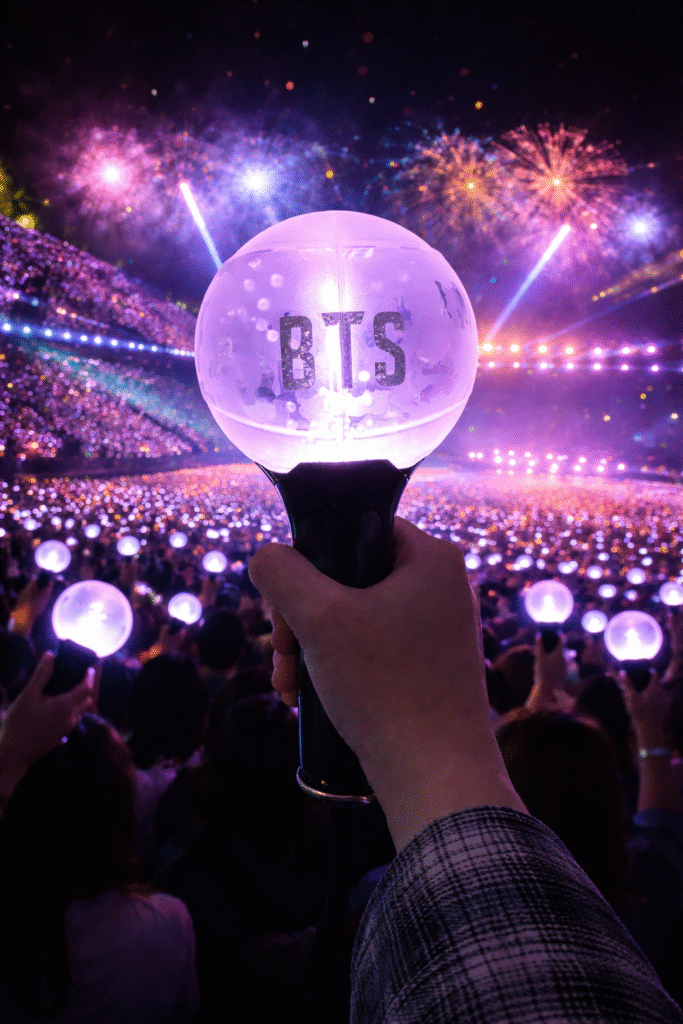
A single light stick becomes part of a coordinated system when thousands of devices are synchronised across a concert audience. Image credit: KorishTech (AI-generated).
At BTS concerts, the audience does not just watch the performance. It becomes part of the visual system.
During live shows, tens of thousands of fans hold official light sticks that change colour, brightness, and timing in perfect synchronisation. The result is not random crowd behaviour. Entire sections of the stadium shift together, forming patterns that move across the audience with precise timing.
This is not driven by individual reactions. It is controlled.
The BTS Concert Light Stick System Builds on K-pop’s Fan Technology
Synchronized light sticks did not begin with BTS. K-pop groups have used coordinated fan lighting for years, evolving from simple coloured balloons to artist-specific light sticks.
BTS introduced its official ARMY Bomb in 2015 as the group expanded into larger venues. What changed over time was not just the design of the device, but how it was used. Instead of acting as a fan accessory, the light stick became part of the concert system itself.
At stadium scale, this turned audience lighting into something structured rather than decorative.
The BTS Concert Light Stick System Works as One Network
The BTS concert light stick system connects thousands of individual devices into a single coordinated output.
Each ARMY Bomb contains LEDs and a wireless communication module. During concerts, these devices are recognised by the venue system and placed into a synchronised network. Once connected, they no longer behave as independent devices.
From that point, the system treats the audience as a distributed display.
Commands Are Broadcast, Not Chosen by Fans
What happens during the concert is not driven by fan input.
Concert systems use centralised wireless control to send instructions to all light sticks at once. BTS concert guidance confirms that supported light sticks are automatically synchronised for stage-linked effects once activated, meaning the system does not depend on individual pairing or manual control.
Each instruction defines colour, brightness, and timing. Because these commands are broadcast rather than individually assigned, thousands of devices can respond simultaneously without delay.
Instead of thousands of separate interactions, there is one command stream and thousands of identical responses. This is how the BTS concert light stick system maintains synchronisation across the entire stadium.
Scale Comes From Synchronisation, Not Complexity
The system does not become more advanced by making each device smarter. It becomes more powerful by increasing the number of devices that follow the same instructions.
A stadium with tens of thousands of light sticks effectively becomes a distributed display. Each device acts as a single pixel within a much larger visual surface. As more fans participate, the resolution and impact of that display increase.
In practice, the control logic is simple. Designers map colours, brightness changes, and timing to specific moments in the setlist before the show. During the concert, the venue system broadcasts those instructions wirelessly, and the light sticks execute them together. BTS concert notices describe supported light sticks as being automatically wirelessly controlled once they are turned on, and they also note that devices far from the stage or blocked by structures may lose signal and fall back to default or user-defined mode.
This makes the system powerful, but not unlimited. It depends on signal coverage, device compatibility, and stable venue conditions.
Industry crowd-lighting systems follow the same principle. Controllers can light an entire venue at once, divide audiences into groups, and previsualise effects in sync with music. The complexity is handled in advance, not during the show.
There is also a practical constraint behind this system. Each light stick is a physical device that fans purchase, maintain, and bring to the venue. That means the system scales with participation, but it also depends on hardware, batteries, wireless support, and event setup. This makes coordination the most efficient way to create large-scale effects without significantly increasing technical complexity inside the venue.
Why This System Does Not Require AI
The behaviour of the system can look intelligent, especially when lighting patterns appear to react perfectly to music. In reality, the sequences are designed in advance.
Lighting patterns are programmed before the concert and triggered at specific moments. The system does not generate visuals or make creative decisions during the performance. It executes pre-defined instructions across all connected devices.
Other live performances use AI more directly. Some artists have used AI to help design stage visuals, and immersive shows are beginning to incorporate AI-generated or responsive elements. These systems focus on generating or adapting content.
The BTS concert light stick system operates differently.
| System | BTS light stick system | AI-driven concert elements |
|---|---|---|
| Core function | Synchronise audience devices | Generate or adapt visuals/audio |
| Logic | Pre-programmed control | Model-based or generative |
| Real-time decisions | Minimal | Higher |
| Audience role | Executes instructions | Usually passive or secondary |
| System type | Distributed control system | AI-assisted performance system |
The difference is structural. One coordinates devices. The other generates content.
The Audience Becomes Part of the Infrastructure
Traditional concerts separate the audience from the stage. Visual effects are produced by screens, lighting rigs, and stage equipment.
In this system, the audience itself becomes part of the infrastructure. The visual layer extends into the crowd, turning spectators into active components of the show.
This changes how scale is experienced. The performance is no longer confined to the stage. It expands across the entire venue through coordinated participation.
Live performance research shows that shared, in-person experiences increase engagement beyond what recorded viewing can reproduce. Systems like this amplify that effect by making participation visible across the entire audience.
Why This Changes How Live Performances Scale
Once the audience becomes a controllable system, the size of the crowd directly increases the capability of the show.
More attendees do not just mean more people watching. They mean more devices contributing to the visual output. The system improves as it grows.
This creates a different model for live performance. A similar shift can be seen in how concerts are distributed globally, as explored in how streaming infrastructure scales events to millions of viewers.
Instead of scaling through larger stages or more complex equipment, scale comes from coordinating what is already there.
My Take
What makes this system powerful is not just the technology, but the relationship it creates between performer and audience.
The BTS concert light stick system shows how a small handheld device can turn fans into part of the infrastructure of the show. This is why the BTS concert light stick system remains effective without requiring fully AI-driven control. The audience is no longer only watching or reacting. It is helping to produce the visible experience inside the venue.
This does not mean the system needs to become fully AI-driven to remain effective. Its current form has already demonstrated how coordinated control can deliver scale, consistency, and strong audience immersion. Live-performance research suggests that shared in-person experiences create deeper engagement than recorded viewing, which helps explain why this system works so well.
The next stage is not necessarily about replacing this system, but building on top of it. There are opportunities to extend how artists and audiences connect across the venue, through streaming, and beyond the concert itself. AI may become part of that layer, particularly in visual design, personalisation, or hybrid live experiences.
But the core lesson remains: before adding intelligence, coordination already turns an audience into part of the performance.
Sources
BTS ARMY Bomb (official light stick system)
https://en.wikipedia.org/wiki/Army_Bomb
Wireless lighting systems in concerts
https://www.livedesignonline.com/lighting/how-wireless-lighting-systems-are-used-concerts
Jean-Michel Jarre on AI in stage visuals
https://www.musicradar.com/artists/were-analog-animals-living-in-a-digital-age-from-ai-driven-stage-design-to-collaborating-with-brian-may-we-speak-with-electronic-icon-jean-michel-jarre
Pingback: How Concert Light Sticks Work (And Are They AI?) | KorishTech