
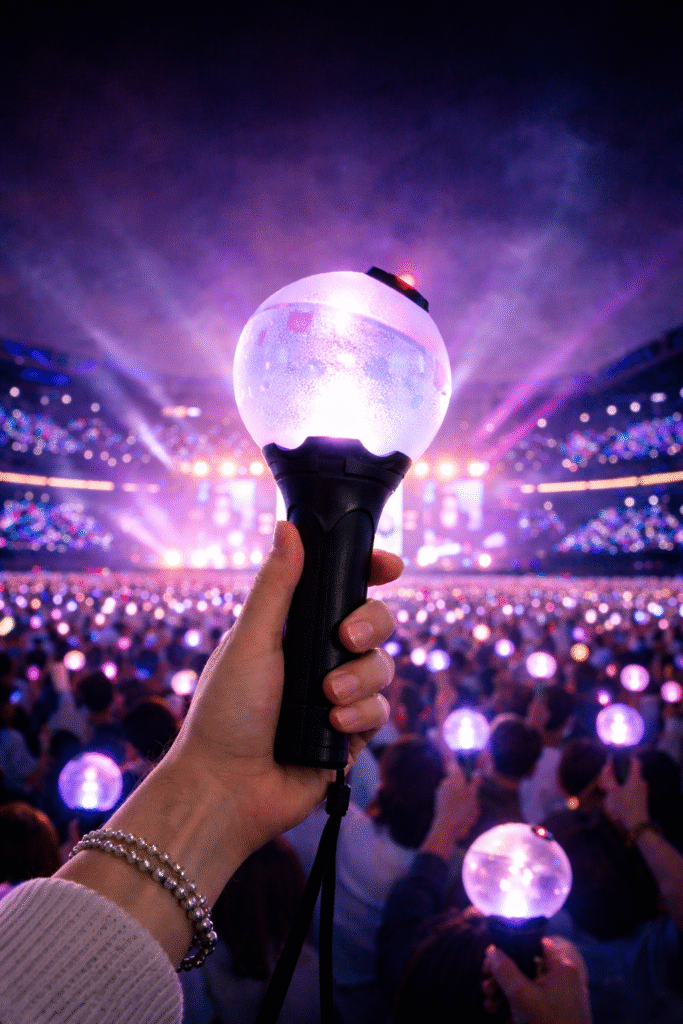
Thousands of light sticks can be controlled together to create synchronised effects across a concert audience. Image credit: KorishTech (AI-generated).
Concert light sticks are not just glowing accessories. At large concerts, how concert light sticks work becomes visible when thousands of fans light up at the same time.
This is why entire stadiums can change colour together, pulse with music, and create patterns across the crowd. It looks intelligent, and many people assume it is powered by AI.
It is not.
How Concert Light Sticks Work as Wireless Devices
A modern concert light stick is a small electronic device. Inside, it contains LEDs, a battery, and a wireless communication component.
In systems like the BTS ARMY Bomb, the device can connect to a smartphone via Bluetooth for setup. This allows fans to register or configure the light stick before the concert. During the show, however, the control does not rely on individual Bluetooth connections. Instead, the device switches into a concert mode where it receives wireless signals from the venue system.
This is what separates it from a simple glow stick. It is not just a light source. It is a device designed to receive instructions and respond as part of a coordinated system.
Unlike disposable or event-only lighting devices, BTS light sticks are also sold as official merchandise. They are designed to be reused across concerts, supported by apps, and compatible with future events, which is why they function both as fan products and concert hardware.
Concert Light Sticks Can Be Controlled Together
At concerts, light sticks can be connected so they work as one system.
There are two common models used in the industry. Some events provide temporary lighting devices to the audience as part of the experience. These are often collected after the show and are controlled entirely by the event organisers. Other systems, like BTS concerts, rely on fan-owned devices that connect to the concert system when activated.
In the BTS setup, supported light sticks automatically enter a concert mode and become part of the show. Once connected, they no longer operate independently. They follow the same instructions as every other device in the venue.
The difference is not just technical but structural. One model treats lighting as an event service, while the other builds it into the fan ecosystem.
One Signal Controls Thousands of Light Sticks
The way concert light sticks work is simple.
A control system sends signals during the performance. These signals tell every light stick what to do, including colour changes, brightness, and timing.
Because the signal is broadcast to all devices at once, thousands of light sticks can respond at the same moment. This is how the BTS concert light stick system can turn an entire stadium’s colour instantly or create patterns that move across the crowd.
Instead of each fan controlling their own device, all devices follow the same signal. This is the core of how concert light sticks work at scale.
How Light Sticks Stay in Sync With the Music
The synchronisation is not created in real time. It is designed before the concert.
Lighting sequences are planned and mapped to each song in advance. Designers decide when colours change, how brightness shifts, and how patterns move across the audience. These sequences are tested and previewed before the show.
During the performance, the system triggers these sequences at specific moments in the setlist. Because every light stick receives the same timing instructions, the entire crowd appears perfectly synchronised.
The effect feels spontaneous, but it is the result of preparation and precise timing rather than live decision-making.
Large-scale events outside BTS concerts follow the same approach. Tours like Taylor Swift’s Reputation Stadium Tour and events such as the Super Bowl have used similar audience-lighting systems to coordinate tens of thousands of devices at once.
Are Concert Light Sticks Controlled by AI?
No, not in their core operation.
Concert light stick systems rely on pre-programmed instructions. They do not learn, adapt, or generate new behaviour during the performance. The system is designed to be predictable and reliable, which is why pre-defined sequences are used instead of AI-driven control.
The main reason AI is not required is not just cost. It is because the task itself does not need AI to work effectively. Concert lighting systems need precise timing, stable signals, and repeatable behaviour. These are easier to achieve with pre-programmed control than with adaptive systems.
That said, AI may still play a role in other parts of live performances. Some artists are already using AI in stage visuals or digital effects. In the future, AI could support areas like visual design, personalisation, or hybrid concert experiences, even if the core audience-lighting system remains controlled.
What Happens If the Signal Fails?
The system depends on stable wireless communication.
If a light stick is too far from the signal source, blocked by structures, or not fully compatible, it may lose synchronisation. In these cases, the device may return to a default colour or allow the user to control it manually.
To reduce this risk, concert organisers design systems with strong signal coverage across the venue. This includes using multiple transmitters, selecting appropriate wireless technologies, and testing the system in advance.
The goal is not to eliminate failure completely, but to ensure that most devices remain synchronised throughout the performance.
These Systems Exist Beyond BTS Concerts
Although BTS has made this system widely known, the same principle is used in many large-scale events.
Companies like PixMob specialise in audience-lighting systems for concerts, festivals, and sports events. They provide wearable LED devices, control systems, and software that allow organisers to coordinate lighting across entire venues.
These systems can light entire audiences at once, divide them into sections, and create effects that move across the crowd. They have been used in major tours and events, including Taylor Swift’s Reputation Stadium Tour and the Super Bowl.
The underlying idea remains the same: one system controls many devices to create a unified visual effect.
Why It Looks So Advanced
Concert light sticks can feel intelligent because of how they are used at scale.
When tens of thousands of lights change together, the audience becomes a large visual surface. Patterns can move across sections, colours can shift instantly, and the entire venue can respond as one.
Some performances go further by creating shapes, waves, or section-based effects across the crowd. These visuals can resemble moving images or large-scale designs, even though each device is only producing simple light changes.
The effect looks advanced not because each device is complex, but because many simple devices are perfectly coordinated.
Want the Full System Explanation?
This article explains how concert light sticks work at a basic level.
If you want to understand how this system operates at a larger scale — including how it turns an entire audience into a coordinated visual display — you can read the full breakdown here:
How BTS Turns Fans Into a Stadium-Sized Screen — Without AI
My Take
Concert performance has improved over time as technology has advanced.
Audience-lighting systems show how small devices can turn fans into part of the performance itself. Instead of only watching, the audience contributes to the visual experience inside the venue.
What makes this powerful is not the complexity of each device, but the coordination between them.
AI may become part of the next stage of live performances, especially in areas like visual design, personalisation, or hybrid live-stream experiences. But the current system already shows that coordinated technology alone can create a strong connection between artists and audiences. This also shows how concert light sticks work without requiring complex AI systems.
Sources
BTS ARMY Bomb
https://en.wikipedia.org/wiki/Army_Bomb
Wireless lighting systems in concerts
https://www.livedesignonline.com/lighting/how-wireless-lighting-systems-are-used-concerts
BTS Weverse concert notice (light stick system)
https://weverse.io/bts/notice/33579
PixMob audience lighting systems
https://pixmob.com/our-effects
AI in stage visuals (Jean-Michel Jarre interview)
https://www.musicradar.com/artists/were-analog-animals-living-in-a-digital-age-from-ai-driven-stage-design-to-collaborating-with-brian-may-we-speak-with-electronic-icon-jean-michel-jarre