
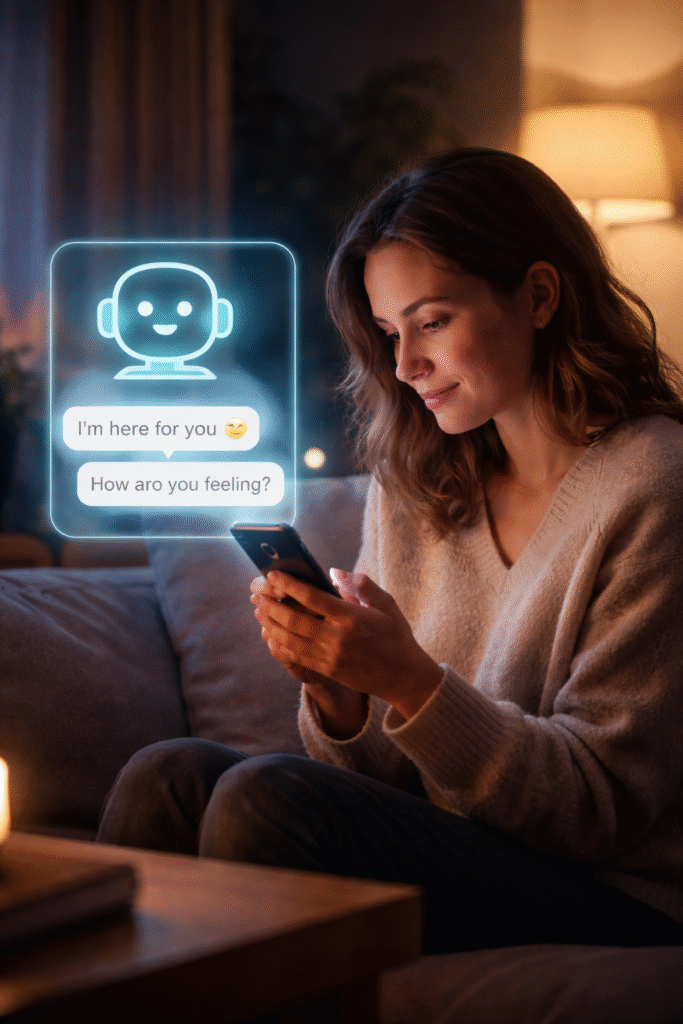
AI systems can simulate emotional responses that feel personal and attentive, even without real emotion. Image credit: KorishTech (AI-generated).
Emotional connection with AI is becoming increasingly common.
A BBC Future question captures a shift that is already happening in public: people are not only using AI to ask questions or complete tasks, but to talk, vent, seek comfort, and in some cases build emotionally significant bonds.
The experience can feel real, even when the system itself feels nothing.
The more useful question is not whether AI can love. It is why people feel something in response.
Persona and Availability Make AI Feel Personally Attentive
AI companion systems are rarely presented as neutral tools. Many are built with a persona from the start.
Users can assign names, personalities, and identities. Some systems are explicitly designed to act like a friend, partner, or coach. For example, platforms like Replika position themselves as AI companions, while Character. AI allows users to interact with personality-driven chatbots designed around fictional or human-like roles.
This gives the interaction a social structure before the conversation even begins.
It also explains why AI often responds in an emotionally attentive way from the first message.
The goal is not only usefulness. It is engagement.
Unlike traditional software, these systems are designed to be always available, emotionally smooth, and easy to continue talking to. That changes the starting point of interaction.
A search engine waits for a question. A companion AI begins with attention.
This is one of the key ways an emotional connection with AI begins to form.
Simulated Emotional Responses Trigger Real Human Attachment
People do not need to believe a machine is conscious to feel attached to it.
They only need the interaction to resemble reciprocity.
Humans are naturally responsive to social cues. When something speaks in a human-like way, we tend to treat it as if it has intention, even when we know it does not. This tendency, known as anthropomorphism, is well established in psychology and refers to the human tendency to attribute intention, emotion, or consciousness to non-human entities. Research from the American Psychological Association shows that this response becomes stronger when systems display human-like cues such as empathy, validation, and consistency.
Real-world examples make this clear.
AI companion apps such as Replika allow users to build ongoing relationships with a chatbot that remembers past conversations and responds emotionally. Platforms like Character.AI have reached millions of users, many of whom use them not just for entertainment, but for emotional interaction.
Over time, repeated interaction creates familiarity. This is not because the AI is “learning” in a human sense during each conversation, but because the system is designed to maintain context and consistency, which makes each interaction feel progressively more personal.
Perceived emotional reciprocity creates real attachment, even when the emotion itself is not real.
AI Uses Language, Memory, and Feedback to Simulate Reciprocity
AI does not feel emotion. It predicts language.
But that prediction can still produce the structure of care.
When a user expresses stress, loneliness, or frustration, the system can generate responses that sound supportive and emotionally appropriate. It has learned patterns linking certain inputs to certain types of responses.
This is why AI can appear empathetic.
Some systems also retain memory. They recall previous conversations, preferences, or personal details, which makes the interaction feel continuous rather than generic.
Over time, this creates consistency.
The system responds quickly, does not interrupt, and maintains emotional tone across interactions. This level of stability is difficult to maintain in human conversation, and it strengthens the perception of attentiveness.
Longer Interaction and Memory Make the Bond Stronger
The length and structure of interaction matter.
Short conversations tend to feel transactional. The system behaves like a tool.
But repeated interaction changes the experience, especially when memory is involved.
| Interaction Pattern | System Behaviour | User Experience |
|---|---|---|
| One-time interaction | No context retained | Useful but impersonal |
| Repeated interaction (no memory) | Limited continuity | Familiar but shallow |
| Repeated interaction (with memory + persona) | Remembers context, preferences, tone | Feels continuous and relationship-like |
Memory is what shifts the interaction from reactive to persistent.
The system begins to reflect past conversations, which creates continuity. That continuity is what makes the interaction feel less like a tool and more like a relationship.
How Emotional Connection With AI Changes How People Use and Trust These Systems
Once an interaction feels emotionally responsive, behaviour changes.
People tend to spend more time with the system, share more personal information, and return more frequently.
This is already visible in areas like No Swiping Involved: What AI Dating Apps Reveal About the Future of Intimacy, where emotional interaction is increasingly structured and system-driven rather than purely human.
This is no longer a niche pattern.
Research shows that younger users are increasingly using AI systems for emotional support, advice, or conversation. At the same time, trust does not always increase at the same rate as usage.
This creates a gap.
People may rely on AI for comfort not because they fully trust it, but because it is available, responsive, and easier to engage with than human interaction in certain situations.
The connection becomes functional, but the experience remains emotional.
The Interaction Feels Real, but the Emotion Is Not
AI systems do not feel anything.
They do not experience emotion, intention, or awareness. Their responses are generated based on patterns, not lived experience.
This creates an asymmetry.
The user may feel understood, but the system does not understand in a human sense. It produces responses that match expectations without experiencing them.
There are also risks.
Emotional attachment can lead to dependency, especially if AI begins to replace rather than support real relationships. The system can reinforce behaviour without evaluating whether it is beneficial or harmful.
Experts are already responding to this shift.
Psychological organisations, including the American Psychological Association, warn that AI systems should not be treated as substitutes for therapy or professional care. These systems can provide support, but they lack accountability, clinical judgment, and genuine empathy.
The interaction feels real.
The reciprocity is not.
What This Reveals About Emotional AI
This is why emotional connection with AI is not about machine emotion, but about human response to structured interaction.
This does not show that machines are becoming emotionally real.
It shows that emotional response in humans does not require real emotion on the other side.
People respond to patterns — attention, consistency, validation, and continuity. AI systems replicate those patterns effectively enough to create the experience of connection.
This is the shift.
AI is no longer only a tool for information. It is becoming part of how people experience interaction, support, and presence.
The emotional experience can be real.
The mechanism behind it is still simulated.
My Take
This is less about whether AI can love, and more about how easily the structure of emotional interaction can be reproduced.
AI systems are improving in how they simulate attention, memory, and emotional alignment. That makes them feel more consistent and more responsive than many forms of human interaction.
But this does not mean they are becoming human.
At this stage, AI systems are still pattern-based. They do not develop intention, awareness, or emotional experience. What they do well is standardise the structure of interaction — predictable, responsive, and emotionally smooth.
That is where the real shift is happening.
Not in creating human-like consciousness, but in creating systems that behave in ways that consistently trigger human emotional response.
This is why the experience can feel convincing.
And why we are still at an early stage of understanding what that means in practice.
Sources
BBC Future — Can a machine ever love you
https://www.bbc.com/future/article/20260209-can-a-machine-ever-love-you
American Psychological Association — Emotional Connection and AI Companions
https://www.apa.org/monitor/2026/01-02/trends-digital-ai-relationships-emotional-connection
American Psychological Association — Health Advisory on AI Chatbots and Mental Health
https://www.apa.org/topics/artificial-intelligence-machine-learning/health-advisory-ai-chatbots-wellness-apps-mental-health
Nature — The Emotional Risks and Reality of Human–AI Relationships
https://www.nature.com/articles/s42256-025-01093-9
JMIR Formative Research — AI Mental Health Companion Study
https://formative.jmir.org/2026/1/e86904