
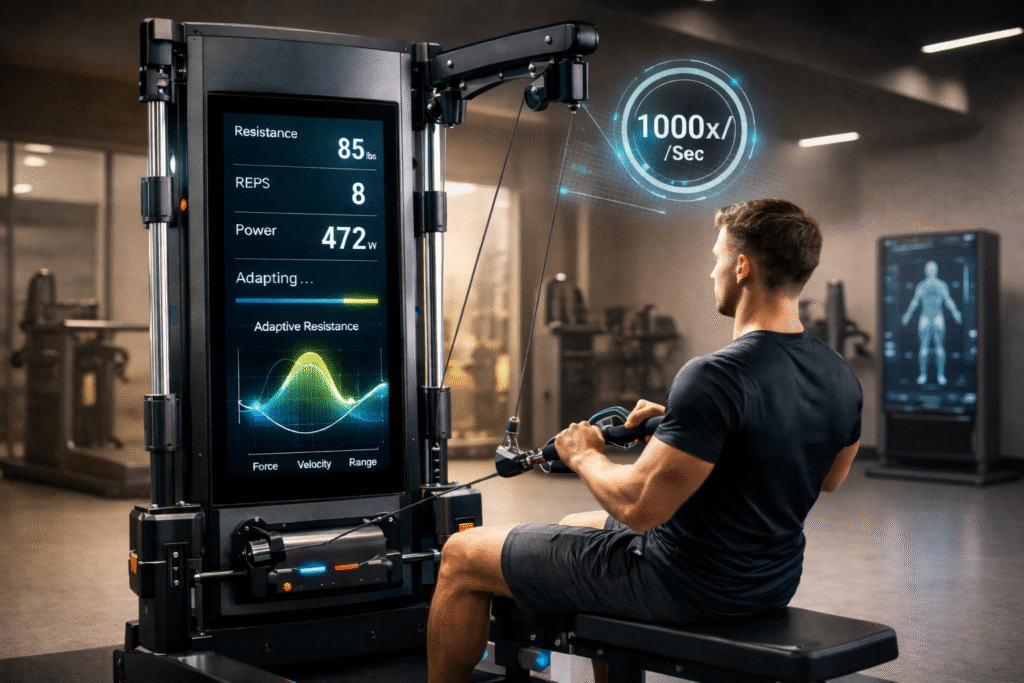
AI fitness machines demonstrate how resistance can adapt in real time based on user performance rather than fixed weights. Image credit: KorishTech (AI-generated).
AI fitness machines are changing how strength training works. In most gyms, strength training still follows the same structure it has for decades.
You choose a weight, perform a set, stop, adjust, and repeat.
AI fitness machines are starting to break that cycle.
Instead of pausing to change the system, the system changes while you are still moving. Resistance adjusts in real time, based on how you perform each repetition.
This shifts the role of the machine.
It is no longer something you use. It becomes something that responds.
How AI Fitness Machines Are Moving From Fixed to Adaptive Resistance
Traditional strength training is built on fixed resistance.
You select a weight, perform repetitions, and manually adjust when needed. The system does not respond to you. You respond to it.
AI fitness machines reverse that relationship.
This shift is not only about convenience. It is driven by measurable changes in how training environments are being built.
The connected gym equipment market was valued at approximately $2.75 billion in 2024 and is projected to reach around $14.0 billion by 2033. This reflects rapid adoption of systems that combine resistance machines with data tracking, performance monitoring, and adaptive control.
These systems extend beyond machines. Many gyms now include body composition scanners, movement analysis tools, and strength-tracking platforms to establish baselines and personalise training loads.
This is how the shift becomes visible.
Training is no longer built only around equipment. It is built around measurement.
At the same time, fixed resistance has practical limitations.
Most gyms increase load in 2.5–5 kg steps. For beginners, this jump can be too large. For advanced users, it can be too coarse to allow precise progression.
Digital resistance systems reduce this gap by allowing fine-grained adjustments, often as precise as 0.5–1 kg or even 1 lb.
But the more important change is continuity.
In traditional training, progression requires interruption. You stop, change weights, reset, and continue.
Adaptive systems remove that interruption.
Resistance changes without breaking the set. Users stay focused on movement and performance rather than equipment adjustment.
This turns strength training from a step-based process into a continuous one.
How Adaptive Resistance Works During a Set
Adaptive resistance operates continuously, not just between sets.
In practical terms, systems like Vitruvian measure force and movement up to 1,000 times per second. This allows resistance to change within the same repetition.
For example, during a squat:
At the bottom of the movement, where strength is lowest, resistance can decrease. As the user drives upward and produces more force, resistance can increase.
This matches how human strength varies through a movement.
Another example is fatigue response.
During a set of 10 repetitions, if repetition speed drops significantly after rep 6, the system can reduce resistance slightly to allow completion without full failure.
Velocity-based adjustments are also used.
If a user moves faster than expected, indicating unused capacity, resistance increases. If movement slows below a threshold, resistance decreases. This creates a feedback loop between performance and load.
Some systems also apply eccentric overload, where resistance increases during the lowering phase of a movement, aligning with research showing that muscles can handle higher loads eccentrically than concentrically.
These adjustments are not random. They are tied directly to measurable performance during the set.
Why This Changes How Strength Training Feels
Adaptive resistance does not just change how weight is applied. It changes how training is experienced.
In fixed systems, effort is uneven.
Early repetitions may feel too easy. Final repetitions may feel too heavy or unsafe. The user constantly adjusts to maintain intensity.
Adaptive systems smooth that experience.
In hypertrophy training, muscle growth depends on maintaining mechanical tension. Adaptive systems help sustain that tension by adjusting load as fatigue builds, allowing users to stay within an effective training range.
In performance training, especially velocity-based models, load is adjusted based on movement speed. Adaptive systems align with this principle, allowing power output to remain within target ranges.
In rehabilitation, controlled progression is critical. Adaptive resistance allows gradual load increases while reducing resistance when instability or fatigue appears.
In high-intensity formats such as CrossFit or HYROX-style training, adaptive resistance reduces time spent adjusting equipment, allowing more continuous effort.
The key difference is consistency.
The system maintains training intensity more evenly across the set, making effort more stable and less interrupted.
Fixed Resistance vs Adaptive Resistance
| Feature | Fixed Resistance | Adaptive Resistance |
|---|---|---|
| Load adjustment | Manual | Automatic |
| During-set changes | No | Yes |
| Response to fatigue | User decides | System adjusts |
| Precision | Limited to available weights | Fine-grained (e.g. 1 lb increments) |
| Training flow | Interrupted | Continuous |
This difference defines the shift.
The change is not about adding AI features. It is about changing how resistance behaves.
What Data These Systems Use
Adaptive resistance systems rely on continuous data collection during training.
The core inputs include force output, movement velocity, range of motion, and repetition quality.
For example, if movement velocity drops by around 20–30%, the system can interpret this as fatigue and adjust resistance accordingly.
Force sensors measure how much load a user can generate at different points in the movement, allowing resistance to change dynamically within a single repetition.
These systems also store data over time.
Workout history, strength levels, repetition performance, and progression trends are logged and used to personalise future sessions. Starting weights are calibrated automatically, and progression is tracked without manual input.
This creates a continuous performance record rather than isolated workouts.
Training becomes a system that learns from past performance, not just responds in the moment.
What Improves — and What Doesn’t
Adaptive systems improve different aspects depending on the user.
For beginners, the main improvement is guidance and safety. This shift is similar to what I Replaced My Personal Trainer with AI — and It Actually Worked shows, where AI systems reduce guesswork but still depend on how users follow and interpret the guidance. The system reduces guesswork, automatically selecting and adjusting resistance.
For users recovering from injury, the improvement is control. Load progression becomes gradual and responsive to movement quality.
For intermediate users, the improvement is consistency. Training intensity is maintained more reliably across sessions.
For advanced users, the improvement is efficiency. Time spent adjusting equipment is reduced, and load can be fine-tuned more precisely.
What does not change is the requirement for effort and progression.
Muscle growth still depends on progressive overload. Strength gains still require sufficient intensity. Performance still depends on structured training.
The system improves delivery. It does not replace the fundamentals.
Where the Limits Still Are
The most immediate limitation is cost.
AI fitness machines typically range from €2,000 to €4,000+, often combined with subscription fees. In comparison, a standard gym membership may cost €30–€80 per month.
This creates a clear accessibility gap.
There are also functional limits.
Adaptive systems work best with controlled, structured movements. They are less suited for complex or sport-specific training that requires variability.
From a scientific perspective, fatigue detection is inferred rather than directly measured. While this aligns with established training models, accuracy depends on execution and system design.
Form tracking systems also have limitations. Vision-based tracking can struggle with complex movements or environmental conditions.
These systems improve precision, but they do not eliminate uncertainty.
What This Reveals About Strength Training
AI fitness machines show how strength training is becoming more measurable and responsive.
The core principles remain unchanged. Progressive overload, mechanical tension, and recovery still define results.
What has changed is how those principles are applied.
Training is moving from estimation to measurement.
Instead of selecting weights based on experience, systems now use real-time and historical data to adjust load and maintain training intensity.
This reflects a broader shift already established in professional sports.
What was once limited to elite environments is now being integrated into consumer systems.
Strength training is becoming less about managing equipment and more about managing performance through feedback.
My Take
AI fitness machines are often framed as a way to replace human judgment in training.
In practice, they are doing something more specific.
They are improving how safely and precisely resistance is delivered.
Adaptive systems reduce load when movement slows, stabilise resistance when fatigue increases, and help prevent sudden failure under heavy weight. This introduces a layer of safety that is difficult to maintain consistently in traditional training, especially for beginners.
But safety in training is not only about the machine.
Human bodies respond differently to the same load, speed, and volume. Two users performing the same exercise can experience different levels of strain, recovery, and risk. This is why coaching still exists.
Understanding how to adjust technique, manage fatigue across sessions, and structure long-term progression remains a human responsibility.
What AI adds is visibility.
These systems generate multiple layers of data — not only the resistance applied, but also movement patterns, performance trends, and indicators of fatigue. Over time, this creates a record that can highlight weak points, imbalances, or potential risk areas that would otherwise be difficult to track manually.
This is particularly relevant in modern training environments.
High-intensity formats, heavy lifting, and high-repetition training increase the risk of injury when load and fatigue are not managed precisely. Adaptive systems reduce some of that risk by adjusting resistance in real time, but they do not remove it.
They shift part of the responsibility from estimation to measurement.
This creates a new requirement.
As these systems collect more data and become more integrated into training, the ability to interpret and use that data becomes more important. Managing training is no longer just physical. It becomes informational.
At the same time, this is still an early stage.
AI fitness machines are improving rapidly, but they are not yet fully reliable across all movement types, environments, or users. Their effectiveness depends on how well they interpret movement and how consistently they are used.
What is likely to change is the surrounding ecosystem.
As adaptive machines become more common, they are likely to be combined with other systems — wearable sensors, recovery tracking, and health data platforms. This will expand how training is monitored and adjusted beyond a single machine.
The result is not a replacement of human training.
It is a shift toward systems that support safer, more measurable, and more personalised training — while still requiring human understanding to use them effectively.
Sources
Tonal — Adaptive Weights and Digital Resistance
https://tonal.com/blogs/all/adaptive-weights-the-future-of-fitness-today
Vitruvian — Adaptive Training Modes Explained
https://knowledge.vitruvianform.com/support/the-training-modes-explained
Grand View Research — Connected Gym Equipment Market
https://www.grandviewresearch.com/industry-analysis/connected-gym-equipment-market