
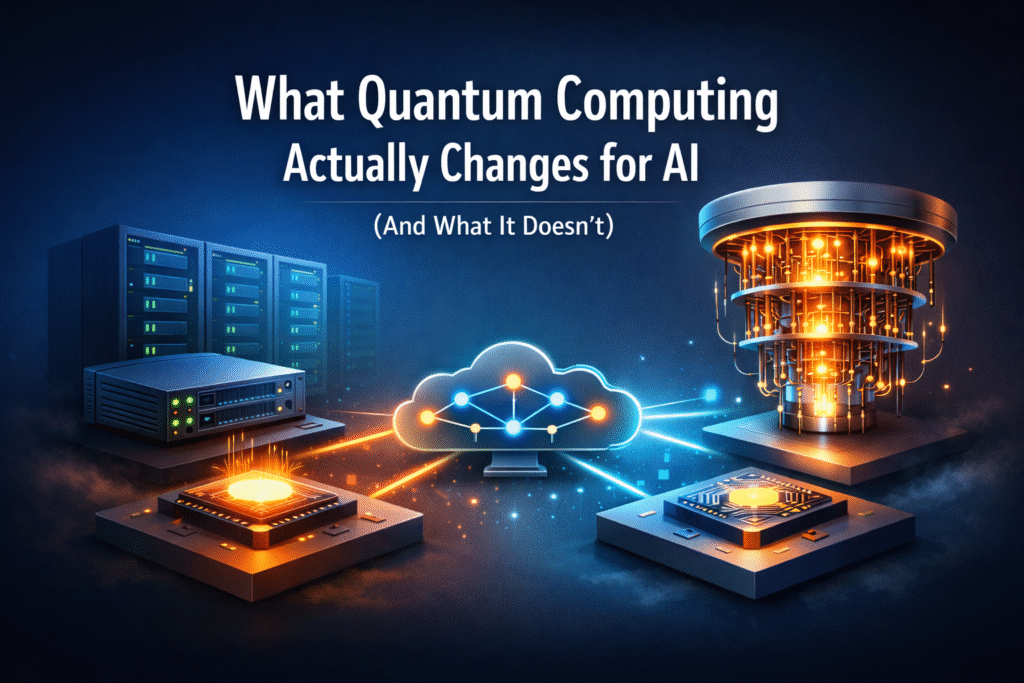
Quantum computing adds a specialised compute layer to AI systems rather than replacing existing infrastructure. Image credit: KorishTech (AI-generated).
Quantum computing AI systems are now being redefined as companies begin positioning quantum as a specialised compute layer alongside existing infrastructure.
Events like World Quantum Day and NVIDIA GTC show that the shift is not that quantum suddenly became usable for AI systems, but that it is now being treated as part of the same compute conversation.
At a broader level, AI systems are already evolving into layered architectures where different types of compute are used for different tasks. This is the same structural shift already visible in AI infrastructure, where systems are increasingly defined by how different compute and control layers work together. Quantum is now being introduced into that structure, not as a replacement, but as a specialised component.
The real change is not capability. It is positioning.
This is why quantum computing AI discussions are shifting from theoretical capability to system-level integration.
Quantum Computing in AI Is Not Faster General Compute
Quantum computing is not a better version of today’s AI hardware. It is a different type of compute designed for a narrow class of problems.
A classical computer processes information as bits, each being either 0 or 1. A quantum computer uses qubits, which can represent combinations of states and be manipulated in ways that help with certain optimisation, sampling, and simulation problems. This does not make quantum universally faster. It makes it useful when the mathematical structure of the problem matches what quantum systems are designed to do.
Google continues to emphasise qubits and decoherence in its public explanations because the core limitation is not theory, but stability. Without stable qubits, computations collapse before producing useful results. IBM and Microsoft frame quantum similarly: not as general-purpose compute, but as a specialised system integrated into broader cloud and high-performance computing environments.
For AI systems, this distinction matters. Quantum would not replace model training, inference, or orchestration. It would sit as a specialised compute layer used selectively when classical systems struggle.
Quantum Is Being Positioned as Infrastructure — Not a Breakthrough
Recent announcements are not about quantum computers running AI models faster. They are about making the technology concrete enough that companies can start designing systems around it.
IBM has outlined a roadmap targeting quantum advantage around 2026 and a fault-tolerant system by 2029. Google has focused on improving qubit stability and reducing decoherence. Microsoft has positioned quantum as a future cloud layer, integrated into infrastructure rather than delivered as a standalone breakthrough.
At NVIDIA GTC, the introduction of Quantum Day was not a product launch. It was an ecosystem signal. Jensen Huang framed quantum as part of a long-term compute stack that already includes GPUs, AI agents, and orchestration systems.
This is the shift. Quantum is no longer being discussed only as research. It is being designed into system architecture.
Quantum Is Being Introduced Where Classical Systems Struggle
Quantum computing is being pulled into AI because certain classes of problems are becoming difficult to solve efficiently with classical systems.
These are not general AI workloads. They are specific bottlenecks:
- large-scale optimisation
- combinatorial search
- probabilistic sampling
- simulation-heavy domains such as chemistry and materials
In these cases, the problem is not lack of intelligence. It is the structure of the search space.
Classical systems explore possibilities step by step. As complexity increases, the number of possible solutions grows faster than compute can handle.
Quantum systems are designed for exactly this constraint.
At the same time, quantum hardware itself requires calibration, error correction, and stability management. AI is already being used to assist with these processes.
This creates a two-way relationship:
- AI helps manage quantum systems
- quantum may assist specific AI subproblems
This is not convergence into a single system. It is the emergence of a layered system.
Quantum Works as a Specialised Compute Layer — Not General Compute
Quantum computing does not replace AI infrastructure. It introduces a specialised compute layer that is only useful under specific conditions.
Classical systems remain responsible for:
- data pipelines
- model training
- inference
- orchestration
Quantum systems become relevant only when the problem matches their strengths:
- optimisation across large search spaces
- probabilistic sampling
- quantum-level simulation
This makes quantum fundamentally different from GPUs.
GPUs accelerate general workloads across AI systems.
Quantum accelerates narrow classes of problems that fit specific mathematical structures.
The result is not substitution. It is selective integration.
This follows the same structural pattern seen when AI systems moved beyond multiple models rather than a single system, with specialised layers replacing one-size-fits-all architecture.
Quantum Sits at the Edge of AI Systems — Not at the Core
If quantum becomes practical, it does not sit at the center of AI systems. It sits at the edges.
A realistic system structure looks like this:
| Layer | Role | Quantum Relevance |
|---|---|---|
| Data processing | cleaning, transformation | low |
| Model training | neural network training | very low |
| Optimisation layer | hyperparameters, scheduling | high (potential) |
| Simulation layer | chemistry, materials | high |
| Inference | serving predictions | negligible |
In practice, quantum would be used as a solver for specific subproblems, not as a general execution engine.
This leads to hybrid architectures where:
- classical compute (CPU, GPU) handles most tasks
- orchestration coordinates execution
- quantum is called selectively for specific computations
Most of AI Infrastructure Remains Hybrid
The main limitation of quantum computing is not lack of attention. It is that the hardware is still too narrow and fragile to become the core layer of AI infrastructure.
Current systems still face:
- high error rates
- instability (decoherence)
- limited qubit counts
- extreme hardware requirements
IBM’s roadmap illustrates this clearly. The milestone is not replacing today’s compute, but building a fault-tolerant system capable of sustained, reliable computation at scale. That is an engineering challenge that is still in progress.
This is why AI infrastructure remains hybrid. Model training, inference, and data processing are still better handled by classical systems and GPU-scale environments. Microsoft’s positioning of quantum within cloud infrastructure reflects this reality: quantum is offered alongside existing systems, not as a replacement.
The practical implication is simple. Quantum adds a specialised layer. It does not replace the stack.
Only Specific AI Bottlenecks Become More Solvable
If quantum computing becomes viable, the main change is not that AI systems become broadly faster or more capable. The change is that certain bottlenecks become easier to solve.
This matters most in domains where the constraint is not model size, but search or simulation:
- logistics optimisation
- molecular discovery
- materials design
- probabilistic modelling
In these cases, the value is not raw speed. It is the ability to explore solution spaces that were previously too complex to compute efficiently.
Quantum does not improve AI as a whole. It improves specific parts of it.
When Quantum Is Applied Incorrectly, Systems Degrade
Quantum computing does not improve performance by default.
If it is applied outside problems that match its structure, it introduces unnecessary complexity without delivering benefits.
For example, replacing classical optimisation in a well-understood system with quantum calls can increase latency, cost, and instability without improving results. The overhead of preparing and validating quantum computations can outweigh any theoretical advantage.
This creates a failure pattern where systems appear more advanced, but perform worse in practice.
The constraint is not capability. It is alignment between problem structure and compute type.
What Does Not Change in AI Systems
Even if quantum becomes practical, the basic structure of AI systems does not disappear.
Data still needs to be collected, processed, and validated. Models still need to be trained and deployed. Inference still needs to operate at scale. Orchestration still needs to coordinate execution across components.
If anything, quantum increases complexity.
Systems must now decide:
- when to use classical compute
- when to use GPU acceleration
- when to call quantum systems
This creates a routing problem.
This is why AI orchestration becomes more important as systems begin coordinating different compute layers inside the same infrastructure.
And that routing must be handled by orchestration.
A more specialised compute environment does not simplify AI infrastructure. It makes coordination more important.
Why This Matters for AI Systems
The significance of quantum computing for AI is not that it makes systems universally faster. It is that it introduces a new type of compute into an already complex infrastructure.
This is the point where quantum computing AI systems move from concept to infrastructure planning.
Today’s AI systems are built around data centres and GPU clusters designed to handle large-scale training and inference. These systems are optimised for throughput, stability, and repeatability. Quantum computing does not replace this foundation. It sits alongside it as a specialised layer, accessed through cloud environments and integrated into high-performance computing workflows.
This creates a structural shift. AI systems are no longer defined by a single dominant compute model. They become multi-layered environments where different types of compute are used for different tasks.
In this structure:
- data centres and GPUs continue to handle general workloads
- orchestration systems coordinate execution
- quantum systems are invoked only when a problem matches their strengths
The impact is not broader intelligence. It is improved problem-solving in areas where classical systems struggle, particularly in optimisation, simulation, and complex search.
This changes how AI systems evolve. Progress is no longer driven only by scaling one type of compute. It is driven by combining different types of compute effectively.
That creates new opportunities, but in a constrained way. Industries that depend on solving high-complexity problems—such as drug discovery, materials science, logistics, and financial modelling—are more likely to benefit. In those domains, even small improvements in optimisation or simulation can produce meaningful outcomes.
At the same time, this introduces a new constraint. As the number of compute layers increases, the system becomes harder to coordinate. The problem becomes less about raw hardware and more about the kind of coordination logic already seen in multi-agent systems, where the system must decide what acts next and why. The challenge shifts from building more powerful models to deciding which system should solve which problem.
This is why quantum computing matters for AI.
It does not redefine the system.
It makes the system more specialised—and therefore more dependent on coordination.
My Take
Quantum computing is entering AI discussions at the architecture stage, not the deployment stage.
That is the important distinction.
Companies are not preparing for a world where quantum replaces existing AI infrastructure. They are preparing for a system where multiple types of compute coexist. Data centres and GPU clusters continue to handle most workloads, while quantum is introduced as a specialised layer for a narrow class of problems.
This changes the nature of progress.
AI is no longer evolving around a single dominant compute model. It is becoming a system of multiple compute types that must be coordinated. That makes the problem less about raw capability and more about control.
The real shift is not that AI becomes “quantum-powered.” It is that systems must decide when quantum should be used at all.
That is a much harder problem than increasing compute.
It introduces a new form of complexity. If quantum is used in the wrong place, it does not improve performance. It makes the system slower, more expensive, and harder to manage. If it is used correctly, it improves specific outcomes in areas where classical systems struggle, such as optimisation and simulation.
This is where the opportunity exists.
Not in replacing AI systems, but in improving the parts of those systems that are hardest to solve.
Industries built around high-complexity problems—such as drug discovery, materials science, logistics, and financial modelling—are more likely to benefit. In those domains, even small improvements in solution quality can have outsized impact.
For most AI systems, nothing fundamental changes.
The models still run on classical infrastructure. The pipelines remain the same. The difference is that the system becomes more specialised, and therefore more dependent on coordination.
Quantum computing does not simplify AI.
It makes the system more fragmented—and more reliant on orchestration to function correctly.
That is why it matters.
Sources
The following sources reflect how leading companies and research organisations currently describe quantum computing, its limitations, and its role within AI systems and infrastructure:
Quantum Computing Fundamentals & Public Explanation
- World Quantum Day
https://worldquantumday.org - Google — World Quantum Day 2026 Explainer
https://blog.google/innovation-and-ai/models-and-research/quantum-computing/world-quantum-day-2026/
Industry Roadmaps & Infrastructure Positioning
- IBM — Quantum Roadmap (Fault Tolerance, 2029 Target)
https://www.ibm.com/roadmaps/quantum/2029/ - Microsoft — Azure Quantum (Hybrid Infrastructure Approach)
https://azure.microsoft.com/en-us/solutions/quantum-computing
AI Infrastructure & Ecosystem Signals
- NVIDIA — GTC 2026 Announcements & Quantum Positioning
https://blogs.nvidia.com/blog/gtc-2026-news/ - Jensen Huang — Commentary on Quantum Timeline
https://www.cnbc.com/2025/03/20/nvidia-ceo-huang-says-was-wrong-about-timeline-for-quantum-computing.html
Quantum + AI Convergence & Use Cases
- AWS — Quantum Computing Overview & Hybrid Workflows
https://aws.amazon.com/quantum-computing/ - Google Cloud — Quantum AI & System Design
https://cloud.google.com/discover/what-is-quantum-computing
Enterprise & Market Perspective
- Gartner — Quantum & AI Adoption Outlook
https://www.gartner.com/en/newsroom - McKinsey & Company — Technology Trends & AI Systems
https://www.mckinsey.com/capabilities/quantumblack/our-insights