
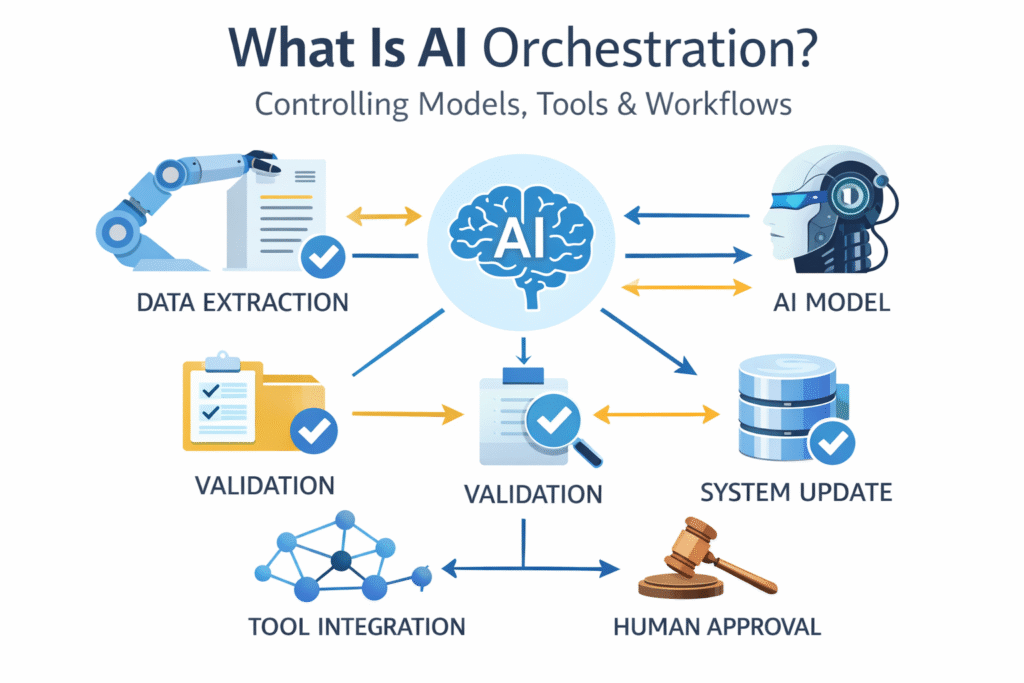
AI orchestration coordinates models, tools, and workflow steps to control how tasks are executed across systems rather than producing isolated responses. Image credit: KorishTech (AI-generated).
What is AI orchestration? It is the control layer that decides what happens next in an AI system so multi-step tasks can be executed reliably.
Enterprise AI platforms like AWS Bedrock and Microsoft Copilot now include orchestration layers to control how models, tools, and workflows are executed across systems.
A single AI model can answer a question. It cannot reliably complete a task that depends on multiple steps.
That is where most AI systems fail.
In real workflows, one step depends on another. If the sequence breaks, the entire task fails — even if each individual step works.
AI orchestration exists to control what happens between those steps so the system does not break.
AI orchestration is the control layer that decides what happens next in an AI system, coordinating models, tools, and workflow steps so multi-step tasks can be executed reliably.
Without orchestration, AI produces outputs.
With orchestration, AI completes tasks.
What AI Orchestration Is Actually Controlling
A model produces an output. That output is not the end of the task.
It becomes the input to the next step.
If that transition is wrong, everything that follows is wrong.
Orchestration controls that transition.
It decides:
- which component acts next
- whether the previous result is usable
- whether to continue, retry, or stop
- how the result is passed forward
These decisions are constrained by:
- cost (cheap vs expensive models)
- confidence (is the result reliable enough)
- policy (is approval required before continuing)
For example, in a document workflow, a system may extract invoice data using a low-cost model. If confidence is low, orchestration routes the task to a more accurate model before allowing the workflow to continue.
Without that decision, incorrect data moves forward.
The system does not fail immediately.
It fails later.
This is what makes understanding what is AI orchestration important, because the system depends on controlled execution rather than isolated responses.
Why Single-Model AI Breaks in Multi-Step Workflows
A single model follows a simple pattern:
input → response → stop
That pattern assumes the task has no dependency chain.
Now return to the document workflow:
- an invoice is uploaded
- data is extracted
- that data is validated
- the result is written into a financial system
Each step depends on the previous one being correct.
If extraction is wrong, validation receives incorrect data.
If validation is weak, the system accepts it.
If the system proceeds, incorrect data is stored.
Once that happens, the error does not stay local.
It propagates.
Incorrect invoice data entering an ERP system can lead to reporting errors, reconciliation issues, and audit risk.
A model is not aware of this chain.
It does not track what happened before. It does not control what happens next.
This is not a limitation of intelligence.
It is a lack of control over execution.
AI Orchestration Is a Control System Built Because Systems Fail Without It
Multi-step systems do not fail inside individual components.
They fail where components connect.
Each component solves a local problem.
None of them manage the system.
This is why orchestration introduces specific roles:
A model produces outputs, but cannot enforce how they are used.
A tool performs actions, but does not decide when those actions should happen.
State stores what has already happened. Without it, the system repeats mistakes or loses context.
Routing logic decides which component should act next based on task type, cost, and expected performance.
A controller evaluates the current state and selects the next action. This is where all decisions converge.
Without a controller, routing, validation, and sequencing exist as disconnected rules rather than a system.
Validation determines whether a step is correct before allowing the workflow to continue.
Human approval exists because some failures cannot be automated safely.
These components are not optional design choices. They exist because systems fail without them.
How AI Orchestration Executes a Workflow (And Why It Must Re-check Every Step)
Orchestration does not follow a fixed sequence.
It operates as a control loop.
Because the system cannot assume the previous step was correct.
Each step must be checked before the next begins.
In practice:
- A task is received
- The system interprets what needs to happen
- It selects the next action
- It executes that action
- It validates the result
- It updates the state
- It decides whether to continue, retry, or stop
This loop continues until the task is complete.
Return to the invoice workflow:
- OCR extracts text
- the model identifies fields
- validation checks totals
If validation fails, the system does not continue.
It may:
- retry extraction
- switch to a stronger model
- escalate to a human
These decisions balance cost, speed, and accuracy.
A cheaper model may succeed most of the time. But when it fails, orchestration must detect that failure and escalate.
Without this loop, the system continues blindly.
That is how small errors become system failures.
Why Multi-Model Systems Fail Without Orchestration
When multiple components operate without orchestration, the failure is not in any single step.
It is in the transitions.
In the same document workflow:
- incorrect OCR output may be accepted
- validation may be bypassed
- incorrect data may be written into ERP systems
At that point, the failure is no longer technical.
It becomes operational.
Financial records become unreliable. Reporting becomes inconsistent. Audit risk increases.
Each component works.
The system fails.
The system does not fail because models are inaccurate.
It fails because there is no mechanism controlling how outputs are used.
How Orchestration Differs from Pipelines and AI Agents
Different system designs fail in different ways.
| System Type | Structure | Failure Mode |
|---|---|---|
| Single Model | One-step response | Cannot handle dependencies |
| Pipeline | Fixed sequence | Continues even when steps fail |
| Orchestration | Dynamic workflow | Controls execution across steps |
| AI Agent | Action-based system | Requires orchestration to remain controlled |
A pipeline assumes the correct path is known in advance.
If one step fails, the system still proceeds.
Orchestration assumes the path must be decided during execution.
This becomes necessary because modern AI systems rely on multiple models rather than a single system (see: Why One AI Model Is No Longer Enough — And What Replaces It).
An agent can act, but orchestration determines whether that action is correct, when it should occur, and what happens next.
Orchestration is not another layer. It is what prevents the system from breaking.
This is also why AI agents require orchestration to operate as structured systems rather than isolated responses (see: What Are AI Agents? (How They Work — And Why Chatbots Can’t Complete Tasks)).
Where AI Orchestration Is Already Controlling Real Systems
Orchestration appears wherever systems must complete tasks, not just respond.
In customer service, the system retrieves account data, evaluates the request, and decides whether to resolve or escalate. Without orchestration, humans coordinate these steps manually.
In document processing, extraction, validation, approval, and system updates are controlled across a workflow. Without orchestration, errors move forward undetected.
In coding systems, the system writes code, runs tests, detects failures, and retries until the result passes validation. Without orchestration, incorrect outputs accumulate.
Across platforms:
- AWS uses routing to balance cost and performance
- Microsoft systems introduce checkpoints and approval layers
- OpenAI systems define controlled handoffs between specialised components
These systems are not more intelligent.
They are more controlled.
What Changes When Orchestration Is Introduced
The key change is not additional capability.
It is that the system no longer depends on the user to coordinate execution.
Without orchestration, the system depends on the user to connect steps correctly. That dependency is where most failures originate.
With orchestration:
- sequencing is controlled
- outputs are validated before progressing
- execution becomes continuous
The system shifts from producing responses to managing workflows.
Where AI Orchestration Still Fails
Orchestration introduces control, but also new risks.
Failures occur when:
- routing selects cheaper options at the expense of accuracy
- state is incomplete or incorrect
- validation fails to detect errors
- external tools or systems fail
- workflows are too rigid to adapt
More control increases complexity.
Each decision point introduces new dependencies.
If those dependencies are not managed, orchestration itself becomes a source of failure.
For simple tasks, this overhead is unnecessary.
Orchestration becomes essential only when failure cannot be tolerated.
What Next
AI orchestration is no longer limited to enterprise systems.
Large platforms such as AWS, Microsoft, and OpenAI have already embedded orchestration into their products, but the same mechanism is now appearing in tools used by individuals.
The difference is not capability. It is abstraction.
At the enterprise level, orchestration is designed explicitly. Teams define workflows, routing rules, validation steps, and approval processes. The structure is visible and controlled.
At the individual level, orchestration is increasingly hidden inside tools.
When someone uses a workflow tool to process emails, summarise documents, and store results, multiple steps are already being coordinated behind the interface. The system decides which model to call, when to use external tools, and how results are passed forward.
This is visible in platforms such as Zapier, Make, and similar workflow tools.
An incoming email can be analysed, categorised, enriched with external data, and stored automatically. What appears to be a simple automation is, in practice, a controlled workflow with routing, validation, and execution decisions.
The same pattern is emerging in coding tools and personal productivity systems.
A coding assistant does not simply generate code. It retrieves context, evaluates results, runs checks, and iterates. The orchestration layer manages that process so the user does not have to coordinate each step manually.
This shows where orchestration is heading.
It is not becoming more visible.
It is becoming more embedded.
For individuals, the shift is already happening. They are not building orchestration systems directly, but they are increasingly relying on systems that manage workflows on their behalf.
My Take
The shift toward AI orchestration is not about making systems more powerful. It is about removing the point where systems depend on human coordination.
Before orchestration, even advanced AI systems required the user to manage the process. A task that involved multiple steps had to be broken down manually. The user would prompt the system, interpret the output, decide the next action, and repeat the process.
That boundary is where most inefficiency exists.
AI orchestration moves that boundary into the system itself.
Instead of asking the user what to do next, the system evaluates the current state and determines the next action. Sequencing, validation, and decision-making are handled internally rather than externally.
This does not make the system broadly autonomous. It makes it structured.
For individuals, this shift is already visible, even if it is not obvious. The tools they use increasingly coordinate workflows behind the scenes. Tasks that once required switching between systems and managing steps manually are now handled as continuous processes.
This changes what it means to use AI effectively.
It is no longer just about asking better questions.
It is about understanding how systems execute tasks, where decisions are made, and how errors are prevented from spreading.
The value of AI is no longer defined by how well it responds.
It is defined by how reliably it completes work.
That is what orchestration enables.
Sources
- OpenAI — Orchestration and agent workflows
https://developers.openai.com/api/docs/guides/agents/orchestration - AWS — Intelligent prompt routing
https://docs.aws.amazon.com/bedrock/latest/userguide/prompt-routing.html - AWS — Document workflow orchestration
https://aws.amazon.com/blogs/machine-learning/orchestrate-an-intelligent-document-processing-workflow-using-tools-in-amazon-bedrock/ - Microsoft — AI workflow architecture
https://techcommunity.microsoft.com/blog/azurearchitectureblog/building-ai-agents-workflow-first-vs-code-first-vs-hybrid/4466788 - Microsoft — Multi-agent orchestration
https://devblogs.microsoft.com/agent-framework/unlocking-enterprise-ai-complexity-multi-agent-orchestration-with-the-microsoft-a - IBM — Automation vs orchestration
https://www.ibm.com/think/topics/automation-vs-orchestration - Zapier — AI orchestration workflows
https://zapier.com/blog/ai-orchestration-workflows/
Pingback: AI Training Data in 2026: Why Human Work Matters | KorishTech