
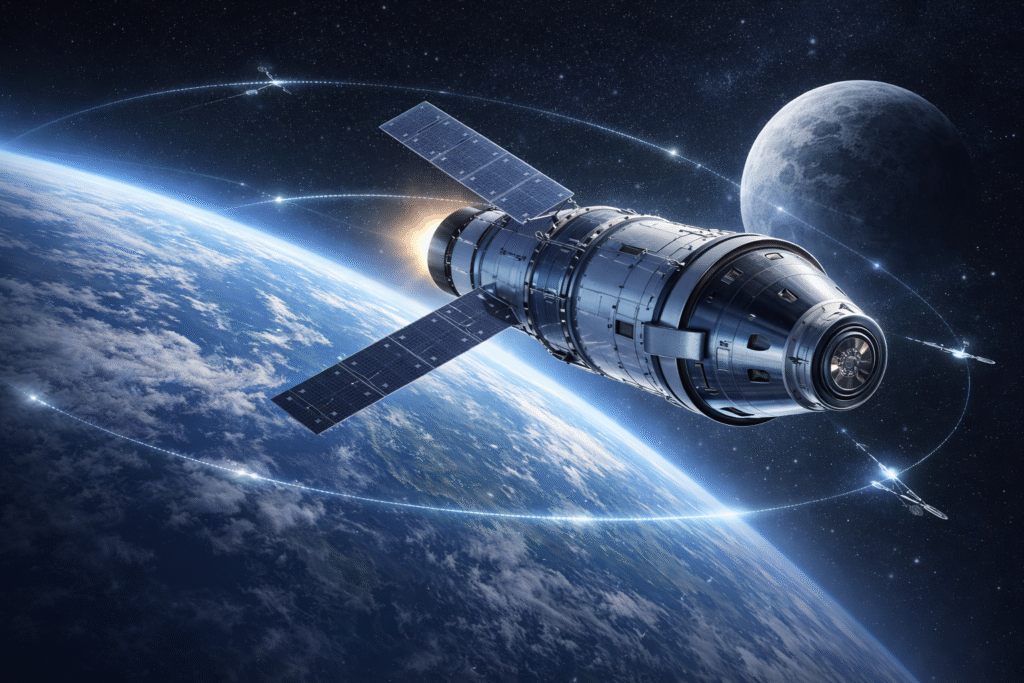
Modern space missions operate as coordinated systems of multiple independent subsystems rather than a single machine. Image credit: KorishTech (AI-generated).
System of systems problems are becoming the defining challenge in modern engineering.
NASA’s Artemis II mission is not limited by how powerful its rocket is or how advanced its spacecraft is. It is limited by whether multiple independent systems can coordinate under strict timing and safety constraints.
This is what defines modern system-of-systems problems. They are no longer single machines. They are systems built from other systems, and the hardest problem is no longer building them, but making them work together.
Modern Missions Are Becoming System-of-Systems Problems
Artemis II is not one system. It is a chain of systems that must operate as one.
The Orion spacecraft carries and supports the crew. The Space Launch System delivers the launch. Ground systems prepare and execute the mission. Communication networks track and connect it across space.
Each of these systems is complete and functional on its own. Modern missions are increasingly structured as system of systems rather than single integrated machines. But the mission only exists when they operate together.
This changes where difficulty lives. The challenge is no longer inside each system. It sits between them, where timing, data, and decisions must align across boundaries.
Modern systems become system-of-systems problems when success depends on these interactions rather than individual performance.
Where Coordination Actually Breaks: Handoffs, Timing, and Interfaces
The most fragile part of a system-of-systems is not the components. It is the moments when responsibility shifts between them.
Artemis II depends on these shifts. Near Earth, one communication system supports the mission. As the spacecraft moves outward, that responsibility transfers to a different network. Each transition must happen without losing visibility or control.
This is where failure risk concentrates.
The systems themselves can perform correctly, but if the handoff is mistimed, incomplete, or misaligned, the mission loses coordination. Commands may arrive late. Data may not be available when needed. Decisions may be made without full system awareness.
This is the difference between system performance and coordination reliability.
The mission does not depend on whether each system works. It depends on whether they stay aligned during transitions.
How Artemis II Is Designed to Survive Coordination Gaps
Artemis II does not try to eliminate coordination gaps. It defines how to operate through them.
Each mission phase assigns responsibility to a specific system and team. Near Earth, ground control and near-Earth communication networks manage coordination. In deep space, this responsibility shifts to deep-space communication infrastructure and corresponding operations teams.
The most critical phase is the lunar far-side blackout.
When the Orion spacecraft passes behind the Moon, communication with Earth stops for around 41 minutes. No commands can be sent, and no real-time monitoring is possible.
This is handled by design, not reaction.
Before entering the blackout, mission control stabilises system states and aligns expectations with the crew. During the blackout, coordination becomes local rather than global. The spacecraft continues operating within predefined parameters, and the crew becomes the primary coordination layer onboard.
When Orion reemerges, deep-space communication systems reacquire the signal. Ground teams verify system health, restore full visibility, and re-align mission operations.
What reduces risk is not continuous control. It is structured control.
| Mission phase | Who coordinates | Coordination challenge | How it is handled |
|---|---|---|---|
| Near-Earth operations | Ground control + near-Earth networks | Multiple systems active during early mission stages | Centralised monitoring and controlled launch-phase coordination |
| Deep-space transition | Mission control + deep-space network teams | Maintaining continuous tracking across increasing distance | Handover between communication systems with defined protocols |
| Lunar far-side blackout | Onboard crew + spacecraft systems | Complete temporary loss of communication with Earth | Predefined procedures, stable system configuration, crew monitoring |
| Reacquisition phase | Deep-space network + mission control | Restoring coordination after blackout | Rapid signal reacquisition, system verification, and resynchronisation |
Coordination is preserved because it is planned across phases, not maintained continuously.
Why Human Safety Makes Coordination Harder
Human safety turns coordination into a constraint that cannot fail silently.
In Artemis II, systems are not only connected. They are safety-dependent. Life support, propulsion, communication, and navigation must remain aligned because the crew depends on all of them simultaneously.
This creates a different type of difficulty.
A technical issue in isolation may be manageable. But once systems are integrated, the impact spreads. A power issue can affect life support. A communication delay can affect decision timing. A timing shift can affect navigation.
This is why NASA focuses on system-level validation.
Issues identified in Orion systems required additional verification not because the components failed completely, but because their behaviour under full mission coordination needed to be understood.
AI can assist in monitoring and analysing system data, identifying anomalies and supporting faster awareness. However, in a crewed mission, it operates within strict boundaries. Decisions involving safety, risk, and coordination across systems remain under human oversight.
Safety increases coordination pressure because uncertainty is no longer acceptable. Every interaction between systems must be predictable enough to protect human life.
Why Humans Still Stay in the Loop
In a system-of-systems, not every situation can be predefined.
Artemis II crews and mission control are trained to manage interactions between systems, not just operate individual ones. When conditions change, they assess multiple signals at once and decide how to respond across the system.
During events such as communication loss or unexpected system behaviour, there is no single automated response that can resolve all dependencies. The situation must be interpreted in context.
Humans bridge that gap.
They prioritise which systems matter most in the moment, decide how to adjust operations, and manage trade-offs across safety, timing, and mission objectives.
AI can support this by analysing telemetry, highlighting anomalies, and assisting decision-making. But it does not resolve coordination across systems under uncertainty.
That responsibility remains human.
What This Reveals About Modern Systems
Artemis II reflects how complex systems are now built and managed.
In aviation, aircraft systems are highly automated, but pilots remain responsible for coordinating system behaviour when conditions change. In power systems, failures rarely come from a single component, but from how systems interact under stress.
What has improved is not simplicity, but coordination design.
This shift is similar to how Why AI Is Moving From Bigger Models to More Efficient Models explains that system performance is now shaped more by constraints than raw capability.
Modern systems now include clearer separation of responsibilities, defined transition points between systems, and structured handling of coordination gaps. Simulation, training, and system-level validation are used to prepare for interaction failures before they happen.
This is why system-of-systems problems are becoming more common in modern engineering.
These do not remove complexity. They make it manageable.
Artemis II shows that modern systems work not because they are simple, but because coordination is designed, tested, and actively managed.
My Take
There is a growing belief that as AI becomes more advanced, human involvement in complex systems will reduce.
The assumption is simple: if AI can perform tasks better than humans, then systems can eventually run themselves.
Artemis II suggests the opposite.
Even in one of the most advanced missions ever built, the limiting factor is not intelligence or capability. It is coordination between systems. And that coordination still depends on how humans design, structure, and manage those systems.
AI can assist. It can analyse data, detect patterns, and improve local performance. But it does not remove the need to align multiple systems operating under different constraints. That layer still requires oversight, judgment, and control.
This shows where we actually are.
We are not at the stage where systems can operate independently end-to-end. There are still constraints — in reliability, energy, predictability, and integration — that prevent full autonomy at the system level.
Until those constraints are resolved, humans remain the coordination layer.
That has an important implication.
The value of human skill is not disappearing. It is shifting.
The critical skill is no longer just executing tasks. It is understanding how systems connect, how they interact, and how to manage coordination across them.
AI may improve individual components. But making systems work together remains a human responsibility.
And that is where the real complexity now sits.
Sources
- NASA Artemis II Mission Overview
https://www.nasa.gov/mission/artemis-ii/ - NASA — Networks Keeping Artemis II Mission Connected
https://www.nasa.gov/missions/artemis/networks-keeping-nasas-artemis-ii-mission-connected/ - NASA Office of Inspector General — Artemis II Readiness Report
https://oig.nasa.gov/wp-content/uploads/2024/05/ig-24-011.pdf - NASA — Orion Spacecraft Overview
https://www.nasa.gov/humans-in-space/orion-spacecraft/orion-overview/ - NASA — Artemis II Crew Training and Mission Preparation
https://www.nasa.gov/centers-and-facilities/johnson/preparing-for-artemis-ii-training-for-a-mission-around-the-moon/