
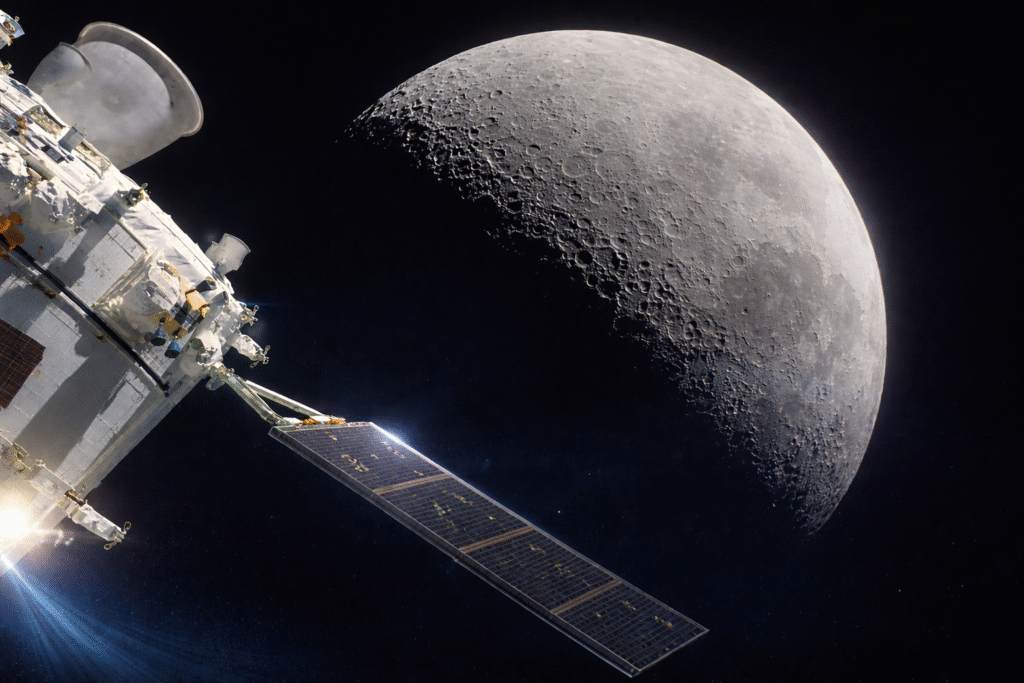
Artemis II highlights how modern missions depend on tightly coordinated systems rather than a single breakthrough. Image credit: KorishTech (AI-generated).
The Artemis II mission marks the first human deep-space flight in over 50 years, but its purpose goes beyond reaching the Moon.
Artemis II is often described as a return to the Moon. But NASA’s published daily agenda reveals something more precise.
This mission is not primarily about reaching the Moon.
It is about proving that a human-rated system can remain stable, coordinated, and safe across every phase of deep-space flight — from launch to lunar flyby to re-entry.
This is not exploration in the traditional sense.
It is system validation under real conditions.
Artemis II Is Not a Moon Mission — It Is a System Test
The mission will last around ten days. Four astronauts will travel aboard the Orion, launched by the Space Launch System, perform a lunar flyby, and return to Earth.
But the structure of the mission makes its purpose clear.
| Phase | What Happens |
|---|---|
| Launch & Orbit | System activation begins immediately after reaching Earth orbit |
| Early Flight | Life support, cabin systems, and crew adaptation are tested in real conditions |
| Translunar Injection | Precise propulsion burn commits the mission to a lunar trajectory |
| Deep Space Transit | Navigation, communication, and radiation procedures are continuously monitored |
| Lunar Flyby | System performance is validated under true deep-space conditions |
| Return & Re-entry | Heat shield, parachutes, and recovery systems are tested for human safety |
At every stage, astronauts are not simply travelling.
They are actively validating whether the system behaves as expected while humans are inside it.
Basic functions — drinking water, managing waste, sleeping, exercising — are not routine. They are part of the test. Emergency drills, manual piloting, and radiation shelter procedures are all rehearsed in real time.
In effect, the crew is operating inside a live system test.
The Difficulty Is Not Distance — It Is Coordination
The difficulty of Artemis II is often explained in terms of distance. Travelling to the Moon remains one of the most demanding journeys humans can attempt.
But distance is not the defining challenge.
The real difficulty lies in coordination under constraint.
Once the spacecraft leaves Earth orbit, there is no immediate rescue option. During lunar flyby, communication is temporarily lost as the spacecraft passes behind the Moon. The crew depends entirely on a closed life-support system, where air, water, and temperature must remain stable for the entire journey.
At the same time, the spacecraft must maintain a precise trajectory. The energy required to leave Earth, loop around the Moon, and return safely must be managed with accuracy. Any deviation affects the ability to come home.
What makes this difficult is not that each system is individually complex.
It is that all of them must operate together, continuously, without failure.
Life support, navigation, propulsion, communication, and human operation are not independent layers. They are interdependent.
That is what defines the mission.
The Delays Reflect System Readiness, Not Failure
Artemis II has been delayed multiple times, but the pattern behind those delays is consistent.
The challenge is not a single technical issue.
It is system readiness.
Before astronauts can be sent into deep space, NASA must verify how multiple systems behave together across all mission phases. This includes how the spacecraft responds to off-nominal scenarios, how life support performs over time, how communication systems behave under delay and blackout, and how recovery operations function after re-entry.
These are not isolated tests.
They are integrated.
The Orion spacecraft, the Space Launch System, the European Service Module, ground communication networks, and recovery systems must all align. Human-rating requirements add another layer, because every system must not only function, but function safely with crew onboard.
This creates a different type of delay.
Not one caused by failure, but by the need to confirm coordination.
AI Supports the Mission — But Does Not Control It
Artemis II is not an AI-driven mission in the way many might expect.
Critical flight operations are controlled by certified software systems and human decision-making, not machine learning models operating autonomously.
But AI is already present within the broader system.
Its role is most visible in telemetry analysis and anomaly detection, where large volumes of spacecraft data are processed to identify irregular behaviour. Systems developed by NEC have contributed to this kind of diagnostic capability. AI has also appeared in experimental interfaces, such as voice-assisted systems tested within Orion to support crew interaction with onboard data.
Across space missions more broadly, AI is increasingly used in navigation support, fault detection, and mission planning. In Artemis II, however, its role remains supportive.
AI helps the system operate more effectively.
It does not replace the system’s core control structure.
What Artemis II Reveals About Modern Systems
Earlier lunar missions established the technical possibility of human travel beyond Earth orbit. Artemis II focuses on something different.
It shows how those capabilities now depend on coordination across far more complex systems.
The mission is not defined by a single spacecraft or a single technological breakthrough. It depends on an integrated environment where hardware, software, human operation, and analytical systems all interact continuously.
This is what has changed.
The complexity is no longer concentrated in one component.
It is distributed across the entire system.
That pattern is not limited to space missions. It is increasingly visible across advanced technologies, including AI systems and infrastructure.
The difficulty has shifted.
From building capability to maintaining coordination.
My Take
Artemis II is often described as a return to the Moon, but that framing feels incomplete.
What stands out more is that this is the first time in decades where this level of effort is being coordinated again — not just technically, but globally. The capability may have existed in parts before, but it was not sustained, prioritised, or funded at this scale.
This mission reflects something different.
It shows what happens when multiple systems, organisations, and countries align around a single objective. Not just to reach a destination, but to validate and improve the technologies that make future missions possible.
Another interesting shift is how the underlying systems have evolved compared to earlier missions. Modern spacecraft rely far more on software, continuous data monitoring, and advanced analysis. AI is already part of this layer — not as a controlling system, but as a supporting one, helping process telemetry, detect anomalies, and improve how engineers understand what is happening in real time.
These changes are not always visible, but they matter.
They show that progress is not only about going further, but about building systems that can operate more reliably, more predictably, and with greater understanding than before.
In that sense, Artemis II is not only about this mission.
It is a step toward the next phase.
Sources
NASA — Artemis II Mission Overview
https://www.nasa.gov/mission/artemis-ii/
NASA — Artemis II Daily Agenda
https://www.nasa.gov/missions/artemis/nasas-artemis-ii-moon-mission-daily-agenda/
NASA — Orion Spacecraft Overview
https://www.nasa.gov/humans-in-space/orion-spacecraft/
NASA — Artemis II Mission Priorities & Objectives
https://www.nasa.gov/wp-content/uploads/2026/03/artemis-ii-mission-prioirities-objectives-.pdf
NASA — Networks Keeping Artemis II Mission Connected
https://www.nasa.gov/missions/artemis/networks-keeping-nasas-artemis-ii-mission-connected/
Lockheed Martin — Callisto Orion Technology Demonstrator
https://www.lockheedmartin.com/en-us/products/callisto-orion-artemis-technology-demonstrator.html
NEC — AI Telemetry Analysis (SIAT)
https://www.nec-labs.com/blog/our-ai-research-contributing-to-nasas-artemis-space-program/