
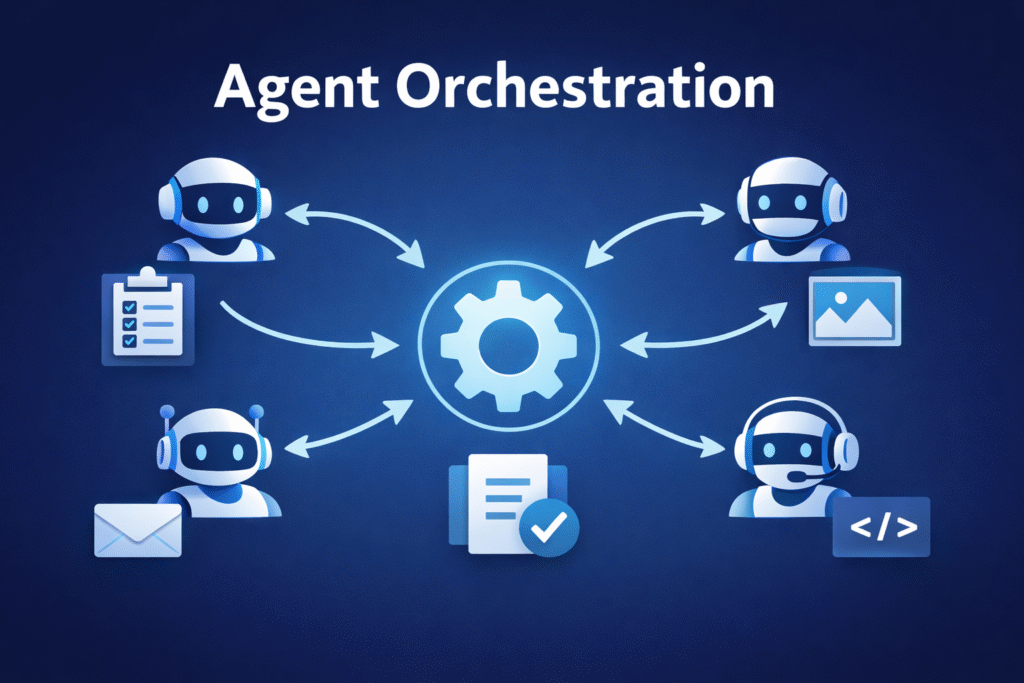
Agent orchestration coordinates multiple AI agents through a control loop, routing tasks, maintaining shared state, and validating each step so the system executes work reliably rather than producing isolated outputs. Image credit: KorishTech (AI-generated)
Agent orchestration works by coordinating multiple AI agents through a control loop that manages execution across steps.
But when multiple agents are used together, the problem is no longer capability. It is coordination.
This is the deeper mechanism behind agent orchestration, where multiple specialised agents are coordinated as a single execution system.
At a broader level, this follows the same logic as AI orchestration, where execution depends on control over what happens next.
Agent orchestration works because it introduces a control loop that decides which agent should act, what information it should use, and whether the result is valid before moving forward. Without that loop, multi-agent systems produce outputs. With it, they execute tasks.
Execution Starts With a Task, Not a Response
A multi-agent system does not begin with a prompt expecting a single answer. It begins with a task that must be completed across multiple steps.
Consider a coding system designed to fix a bug. The goal is not to generate text. It is to identify the issue, modify the code, test the result, and confirm that the fix works.
A single agent cannot reliably perform all of these steps because each step requires different constraints, tools, and validation conditions.
In a coding system, identifying a bug requires analysis of existing code, modifying it requires controlled generation, and verifying the fix requires executing tests in a real environment. These are not variations of the same task. They are fundamentally different operations with different failure modes.
When one agent attempts to handle all of them, it must switch between roles without clear boundaries. This creates ambiguity in decision-making, weak validation, and a higher risk of silent errors. The system may produce outputs that appear correct, but fail when executed or tested.
Breaking the task into specialised agents removes this ambiguity. Each agent operates within a defined role, with clear inputs and expected outputs. Orchestration then coordinates these roles into a controlled sequence.
This becomes necessary because modern AI systems increasingly rely on multiple models rather than a single system, making specialised coordination part of the architecture rather than an optional layer.
This is not a limitation of intelligence. It is a limitation of system design.
The Controller Decides Which Agent Acts Next
At the centre of the system is a controller.
The controller is responsible for the overall task. It does not write code, run tests, or retrieve data directly. Instead, it evaluates the current state of the task and decides which agent should act next.
This only works because the system is built from specialised AI agents with different roles, rather than a single chatbot trying to manage every part of the task.
In the coding example:
- After receiving the task, the controller assigns analysis to a diagnostic agent
- Once the issue is identified, it routes the task to a coding agent
- After changes are made, it sends the result to a testing agent
Each decision depends on what has already happened.
The controller does not follow a fixed sequence. It evaluates the current state against the desired outcome.
If the task is incomplete, it identifies what condition is missing. That missing condition determines which agent is required next. If code has been modified but not verified, the system routes to testing. If tests fail, it routes back to modification.
The decision is driven by gaps between the current state and the expected outcome, not by a predefined workflow.
Without this layer, agents would act independently, and the sequence would break.
This is where agent orchestration becomes critical, because the system must continuously decide how execution should proceed across agents.
Task Routing Assigns Work to the Right Agent
Routing is the mechanism that connects the controller to the agents.
It determines which agent is responsible for each part of the task based on:
- The type of subtask
- The required capability
- The current state of execution
In the coding system, routing ensures that the diagnostic agent is not asked to write code, and the coding agent is not asked to validate results.
If routing is incorrect, the system does not simply slow down. It breaks alignment between steps.
For example, sending incomplete or incorrect code to a testing agent produces failures that are not caused by logic errors, but by missing or invalid inputs. The testing agent then reports failure without context, and The system begins solving the wrong problem while appearing to make progress.
This is how errors propagate. A routing mistake early in the process leads to increasingly incorrect decisions in later steps.
Routing is not a supporting feature. It is a core mechanism that determines whether the system remains aligned with the task.
Shared State Keeps All Agents Aligned
For a multi-agent system to work, all agents must operate on the same understanding of the task.
This is maintained through shared state.
State includes:
- The original task
- Intermediate outputs
- Decisions already made
- Results from previous agents
In the coding example, once the diagnostic agent identifies a bug, that information must be stored so the coding agent can act on it. After the code is modified, the updated version must be passed to the testing agent.
If state is incomplete or inconsistent, agents begin to operate on different versions of the task. One agent may act on outdated information while another uses updated results.
This creates divergence, where the system no longer follows a single path. Instead, conflicting execution paths emerge, and coordination collapses.
State is what allows multiple agents to behave as a single system rather than independent components.
The Coordination Loop Drives Execution
The coordination loop is the mechanism that replaces a fixed workflow with a controlled, adaptive execution process.
The system does not execute once. It continuously evaluates and adjusts until the task is complete.
The loop follows this structure:
- Inspect the current state
- Decide the next action
- Route the task to the appropriate agent
- Execute the step
- Validate the output
- Update the state
- Repeat
In the coding system:
- The system inspects whether the bug is resolved
- If not, it determines what is missing
- It routes the task to the appropriate agent
- Executes the step
- Validates through testing
- Updates the state
- Repeats until completion
This loop is what turns a collection of agents into an executing system.
Without it, there is no mechanism to adapt, correct, or continue. The system becomes a sequence of disconnected actions rather than a controlled process.
Validation and Failure Handling Prevent System Collapse
Multi-agent systems do not fail at a single point. They fail through accumulation.
If one step produces an incorrect result, and that result is not validated, every subsequent step builds on that error.
Orchestration introduces validation at each stage.
This includes:
- Checking whether outputs meet expected conditions
- Retrying failed steps
- Switching to alternative agents
- Escalating to human review when necessary
In the coding example, if tests fail after a code change, the system does not proceed. It re-enters the loop, adjusts the approach, and attempts a corrected solution.
Without validation, the system continues executing steps that appear correct but lead to failure during execution.
This introduces a trade-off. More validation improves reliability, but increases latency and cost. Systems must balance how often to validate against how quickly they need to respond.
Execution Without Orchestration vs With Orchestration
| Aspect | Without Orchestration | With Orchestration |
|---|---|---|
| Task flow | Disconnected steps | Controlled sequence |
| Agent coordination | Independent actions | Directed by controller |
| State management | Fragmented or missing | Shared and updated continuously |
| Error handling | Errors propagate silently | Errors detected and corrected |
| Outcome | Appears correct but fails during execution | Reliable task completion |
The difference is not in what each agent can do. It is in whether the system can coordinate those actions into a coherent execution process.
Why Agent Orchestration Enables Reliable Multi-Agent Systems
Agent orchestration works because it introduces structure where coordination would otherwise fail.
Each component addresses a specific constraint:
- The controller ensures direction
- Routing ensures correct assignment
- State ensures continuity
- Validation ensures stability
Together, these form a system that can execute tasks across multiple agents without losing alignment.
Without this mechanism, adding more agents increases complexity but reduces reliability.
My Take
The shift to multi-agent systems exposes a structural limit in how AI systems operate.
Each agent can perform a function. But real tasks are not collections of independent functions. They are sequences where each step depends on the correctness of the previous one.
Before orchestration, that dependency was managed externally. The user interpreted outputs, decided what to do next, and corrected mistakes manually.
Agent orchestration internalises that responsibility.
This changes the role of the system. It is no longer evaluated by how well it generates responses, but by how reliably it manages execution across steps.
This is where coordination becomes the dominant constraint.
Adding more agents does not improve performance if their interaction is not controlled. In fact, it increases the probability of failure, because more dependencies are introduced between steps.
The critical capability is not intelligence at the component level. It is control at the system level.
This is why orchestration is not an enhancement. It is the condition required for multi-agent systems to function at all.
Without it, the system produces outputs that appear useful. With it, the system executes work that can be trusted.
Sources
Agent orchestration and multi-agent coordination are increasingly defined as system-level control problems rather than model capability problems. The following sources reflect how major platforms and research organisations describe orchestration, routing, and multi-agent systems in practice:
OpenAI — Orchestration and Multi-Agent Systems
https://developers.openai.com/api/docs/guides/agents/orchestration
OpenAI Cookbook — Orchestrating Agents
https://developers.openai.com/cookbook/examples/orchestrating_agents
AWS — Multi-Agent Collaboration and Prompt Routing (Amazon Bedrock)
https://docs.aws.amazon.com/bedrock/latest/userguide/prompt-routing.html
AWS — Intelligent Document Processing with Orchestration
https://aws.amazon.com/blogs/machine-learning/orchestrate-an-intelligent-document-processing-workflow-using-tools-in-amazon-bedrock/
Microsoft — AI Agent Workflow and Orchestration Patterns
https://techcommunity.microsoft.com/blog/azurearchitectureblog/building-ai-agents-workflow-first-vs-code-first-vs-hybrid/4466788
IBM — Automation vs Orchestration
https://www.ibm.com/think/topics/automation-vs-orchestration
Gartner — Enterprise AI and Multi-Agent Systems Forecast
https://www.gartner.com/en/newsroom
McKinsey — The State of AI
https://www.mckinsey.com/capabilities/quantumblack/our-insights/the-state-of-ai
Google Cloud — AI Agents and System Design
https://cloud.google.com/discover/what-are-ai-agents