
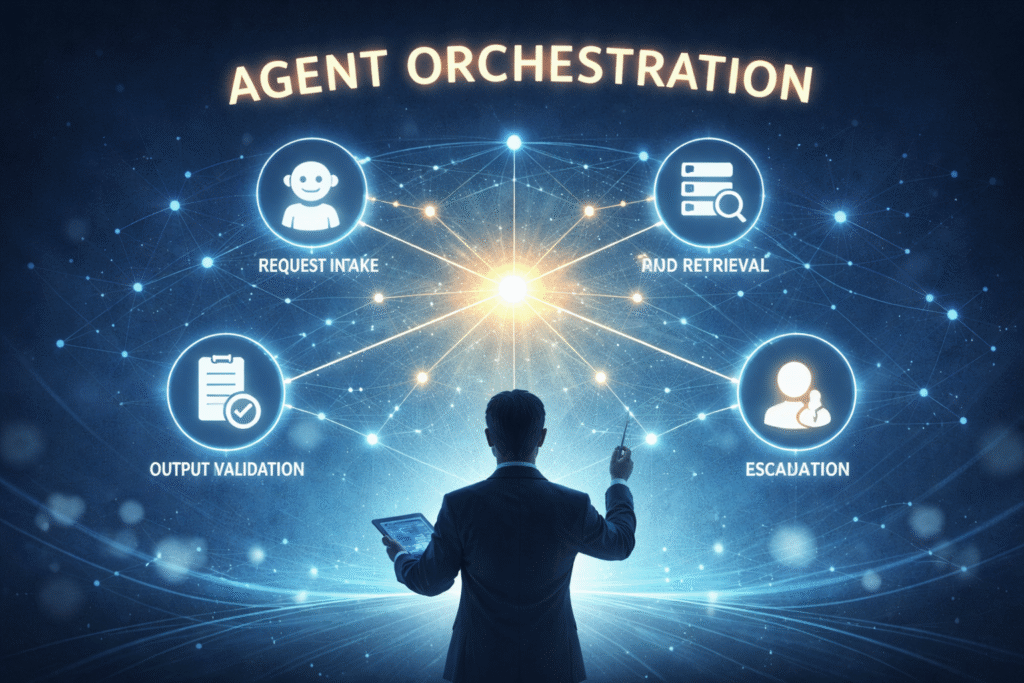
Agent orchestration coordinates multiple AI agents through a central control layer, allowing specialised components to execute tasks as a single structured system rather than isolated steps. Image credit: KorishTech (AI-generated)
AI orchestration coordinates models, tools, and workflows. Agent orchestration goes one step further.
What is agent orchestration? It is the control layer that decides how multiple AI agents work together so a task can be completed as one system rather than as disconnected steps.
A single AI agent can interpret a request and attempt to complete it. But once a task requires different types of work—retrieving data, applying rules, validating outputs, or escalating decisions—one agent becomes overloaded. Agent orchestration exists to coordinate multiple specialised agents so the task can be distributed and executed in a controlled way.
What Agent Orchestration Is Actually Controlling
Agents perform actions. Orchestration decides which agent should act, when it should act, and what information it should receive.
Each agent is designed for a specific role. One agent may interpret a request. Another may retrieve data. Another may validate results. On their own, these agents do not form a system.
Orchestration connects them.
This is also why AI agents require orchestration to operate as structured systems rather than isolated responses.
It controls:
- which agent is responsible for the current step
- how outputs are passed between agents
- whether the system should continue, retry, or escalate
- when the task is considered complete
For example, in a customer support system, a request such as “Where is my order?” is not handled by one agent alone. One agent interprets the request, another retrieves order data, another checks delivery status, and another decides whether escalation is required. Orchestration ensures these agents act in the correct order and with the correct information.
Without that control, each agent may still function individually. But the task does not complete reliably.
This is what makes agent orchestration essential, because the system depends on controlled execution rather than isolated agent outputs.
How Multiple AI Agents Work Together
Agent orchestration turns separate agents into a coordinated structure.
In most systems, this structure includes a controller and multiple specialist agents.
The controller (sometimes called a supervisor or manager agent) is responsible for the overall task. It does not perform every step itself. Instead, it decides which specialist agent should handle each part of the task.
Specialist agents are designed for narrow responsibilities. For example:
- an intake agent to interpret the request
- a retrieval agent to access data
- a validation agent to check outputs
- an escalation agent to involve a human if needed
Agents communicate either through controlled handoffs or through a central controller that passes results between them. Each step depends on the output of the previous one, which means coordination is required for the system to function correctly.
This structure is already visible in real tools. In coding environments such as Cursor, different agent-like roles are used implicitly, where one component plans changes, another generates code, and another verifies results. In workflow tools like n8n, users define multi-step logic that increasingly includes AI agents performing specialised tasks. In both cases, the system only works when execution is controlled. Without coordination, each step produces output, but the overall task does not complete reliably.
Why Multi-Agent Systems Fail Without Orchestration
When multiple agents are used without orchestration, the system fails at the boundaries between them.
Common failures include:
- duplicated work, where multiple agents attempt the same task
- conflicting outputs, where agents produce incompatible results
- wrong agent selection, where a task is routed incorrectly
- missing steps, where required actions are skipped
These failures are not theoretical. In early attempts to run fully autonomous systems, including AI-managed online stores, systems often failed not because individual components were weak, but because coordination broke down. Tasks were executed out of order, inventory decisions conflicted with pricing logic, and no component maintained responsibility for the overall outcome. The system continued operating, but the result drifted away from the intended goal.
This pattern appears in smaller individual setups as well. When users connect multiple AI tools without clear control, outputs may look correct at each step but fail when combined. The problem is not intelligence. It is coordination.
Consistency becomes difficult because each agent operates on its own context. Without shared state and controlled sequencing, agents can lose track of the task or act on outdated information. Errors do not stay isolated. They propagate from one step to the next.
Agent orchestration reduces these failures by enforcing order, maintaining shared context, and ensuring that each step is validated before the system moves forward.
Agent Orchestration vs a Single AI Agent
A single AI agent attempts to handle all aspects of a task within one system.
This works for simple or well-defined tasks. But as tasks become more complex, the agent must manage too many responsibilities at once.
Agent orchestration introduces specialization.
This becomes necessary because modern AI systems rely on multiple models rather than a single system.
Instead of one agent doing everything, multiple agents handle different parts of the task. The orchestrator ensures that these parts connect correctly.
The difference is not just scale. It is structure.
| Factor | Single AI Agent | Agent Orchestration |
|---|---|---|
| Task complexity | Best for simple tasks | Required for multi-step tasks |
| Speed | Faster (one step) | Slower (multi-step coordination) |
| Reliability | Lower for complex tasks | Higher with validation and control |
| Cost | Lower | Higher (multiple agents) |
| Risk | Lower (limited scope) | Higher if coordination fails |
| Scalability | Limited | High (specialisation possible) |
| Control | Implicit | Explicit (system-managed) |
The difference is not capability alone. It is whether the system can coordinate multiple responsibilities without breaking.
A Real Example: Customer Support System
A customer support system provides a clear example of agent orchestration in practice.
A user submits a request:
“Where is my order?”
The system processes this request as a sequence:
- An intake agent interprets the question
- A retrieval agent queries the order database
- A status agent checks delivery progress
- A validation agent confirms the result
- An escalation agent decides whether human support is required
Each agent performs a specific role. But none of them can complete the task alone.
The orchestration layer coordinates these steps, ensuring that each agent receives the correct input and that the final response reflects the full process.
Without orchestration, the system would require manual coordination between these steps. With orchestration, the system operates as a single unit.
Agent orchestration assumes that the task can be broken into steps. Without a clear structure or objective, coordination becomes unreliable.
What Changes When Agent Orchestration Is Introduced
When agent orchestration is introduced, the system shifts from a single execution loop to a coordinated structure.
The task is no longer handled by one agent attempting to do everything. It is handled by multiple agents working together under controlled conditions.
This changes how the system behaves:
- tasks are distributed across specialised agents
- execution is sequenced and validated
- context is maintained across steps
- decisions about what happens next are made by the system
This shift happens in two different ways.
For companies, agent orchestration is introduced to replace fragmented systems. Tasks that previously required switching between tools, teams, or manual steps are consolidated into a controlled system.
For individuals and freelancers, the shift often starts from zero. Instead of building a traditional workflow, they define roles such as researcher, writer, or reviewer, and allow the system to coordinate these roles automatically.
In both cases, the change is the same. Coordination moves from the user into the system.
Limits and Trade-Offs
Agent orchestration introduces additional complexity.
The system must manage:
- routing decisions between agents
- shared state across steps
- validation of intermediate results
- handling of failures and retries
If orchestration is poorly designed, the system may route tasks incorrectly or lose context between agents. This can make the system slower or less reliable rather than more effective.
Not all tasks require multiple agents. For simple, single-step tasks, a single agent is often sufficient. Orchestration becomes necessary only when tasks require coordination across multiple specialised roles.
What Next: Where Agent Orchestration Is Already Used
Agent orchestration is already being used in systems that coordinate multiple AI components behind a single interface.
Platforms such as AWS, Microsoft, and OpenAI include orchestration capabilities that allow multiple agents to work together. These systems often use a controller pattern, where a central agent coordinates specialist agents depending on the task.
For individuals, this is becoming increasingly accessible. Instead of manually switching between tools, users can define multiple roles and allow the system to coordinate them. Tools like n8n or AI-enabled coding environments such as Cursor already show early forms of this approach.
This does not require building a full enterprise system. It requires defining clear responsibilities and allowing a control layer to manage execution.
The shift is already visible. AI systems are moving from single-agent interactions toward coordinated multi-agent execution.
My Take
The shift to agent orchestration is often described as making AI systems more powerful. That description misses what is actually changing.
The real shift is structural.
A single agent can produce an answer, but it struggles when a task requires different types of work to be completed in sequence. Each step depends on the previous one, and the system must maintain consistency across all of them. Without coordination, even strong individual components fail when combined.
Agent orchestration addresses that constraint.
It does not make agents smarter. It makes them work together in a controlled way.
This is why many early attempts at fully autonomous systems fail. The issue is not that the agents cannot perform individual tasks. It is that no part of the system is responsible for ensuring those tasks connect correctly. The result is a system that appears functional at each step but produces unreliable outcomes overall.
For individuals, this shift reduces the need to manually coordinate multiple tools or prompts. Instead of deciding each step, the user defines the objective and the system manages execution.
For companies, the impact is larger. Processes that previously required multiple systems, handoffs, or human coordination can be consolidated into a structured workflow. But this also introduces a new responsibility. The system must now be designed, monitored, and controlled at the orchestration level.
This is where many systems still fail today.
Agent orchestration does not remove the need for planning or oversight. It moves that responsibility into system design.
That is the real boundary.
AI systems are no longer limited by what a single model can do. They are limited by how well multiple components can be coordinated.
Sources
OpenAI — Orchestration and Multi-Agent Systems
https://developers.openai.com/api/docs/guides/agents/orchestration
OpenAI — A Practical Guide to Building Agents
https://cdn.openai.com/business-guides-and-resources/a-practical-guide-to-building-agents.pdf
AWS — Multi-Agent Collaboration in Amazon Bedrock
https://docs.aws.amazon.com/bedrock/latest/userguide/agents-multi-agent-collaboration.html
AWS — Multi-Agent Orchestration Architecture Guidance
https://aws.amazon.com/solutions/guidance/multi-agent-orchestration-on-aws/
Microsoft — AI Agent Design Patterns (Azure Architecture)
https://learn.microsoft.com/en-us/azure/architecture/ai-ml/guide/ai-agent-design-patterns
Microsoft — Agent Framework and Orchestration Patterns
https://learn.microsoft.com/en-us/agent-framework/workflows/orchestrations/
Microsoft — Agent Framework Overview
https://learn.microsoft.com/en-us/agent-framework/overview/
Gartner — Enterprise Adoption of AI Agents (2025–2026 Forecast)
https://www.gartner.com/en/newsroom/press-releases/2025-08-26-gartner-predicts-40-percent-of-enterprise-apps-will-feature-task-specific-ai-agents-by-2026-up-from-less-than-5-percent-in-2025
AWS — Prescriptive Guidance on Agentic AI Frameworks
https://docs.aws.amazon.com/prescriptive-guidance/latest/agentic-ai-frameworks/